
For decades, proving that a generic drug works the same as the brand-name version meant running clinical trials in healthy volunteers. You’d give 24 to 36 people the brand drug, then give them the generic a week later, and measure blood levels over hours. It was expensive-often costing between $500,000 and $2 million per study-and slow, adding months to the approval timeline. But now, a smarter, science-backed method is cutting those tests out: IVIVC. It’s not magic. It’s math. And it’s changing how generic drugs get approved.
What IVIVC Actually Means (And Why It Matters)
IVIVC stands for In Vitro-In Vivo Correlation. In plain terms, it’s a way to predict how a drug will behave in your body based on how it dissolves in a lab test. Think of it like this: if you know how fast a pill breaks down in a beaker under conditions that mimic your stomach, you can accurately guess how much of the drug will enter your bloodstream-and when.
This isn’t just theoretical. The U.S. Food and Drug Administration (FDA) officially recognized IVIVC in 1996 and updated its guidance in 2014. The European Medicines Agency (EMA) followed suit. Both now accept IVIVC as a valid substitute for human bioequivalence studies under the right conditions. That means companies can skip the costly, time-consuming clinical trials and instead rely on dissolution tests to prove their generic drug is equivalent.
Why does this matter? For patients, it means faster access to affordable medicines. For manufacturers, it means saving $1-2 million per avoided study and cutting 6-12 months off development time. For regulators, it means fewer human trials without compromising safety.
The Four Levels of IVIVC: Not All Correlations Are Equal
Not every IVIVC is created equal. The FDA classifies them into four levels, and only some are good enough to replace human testing.
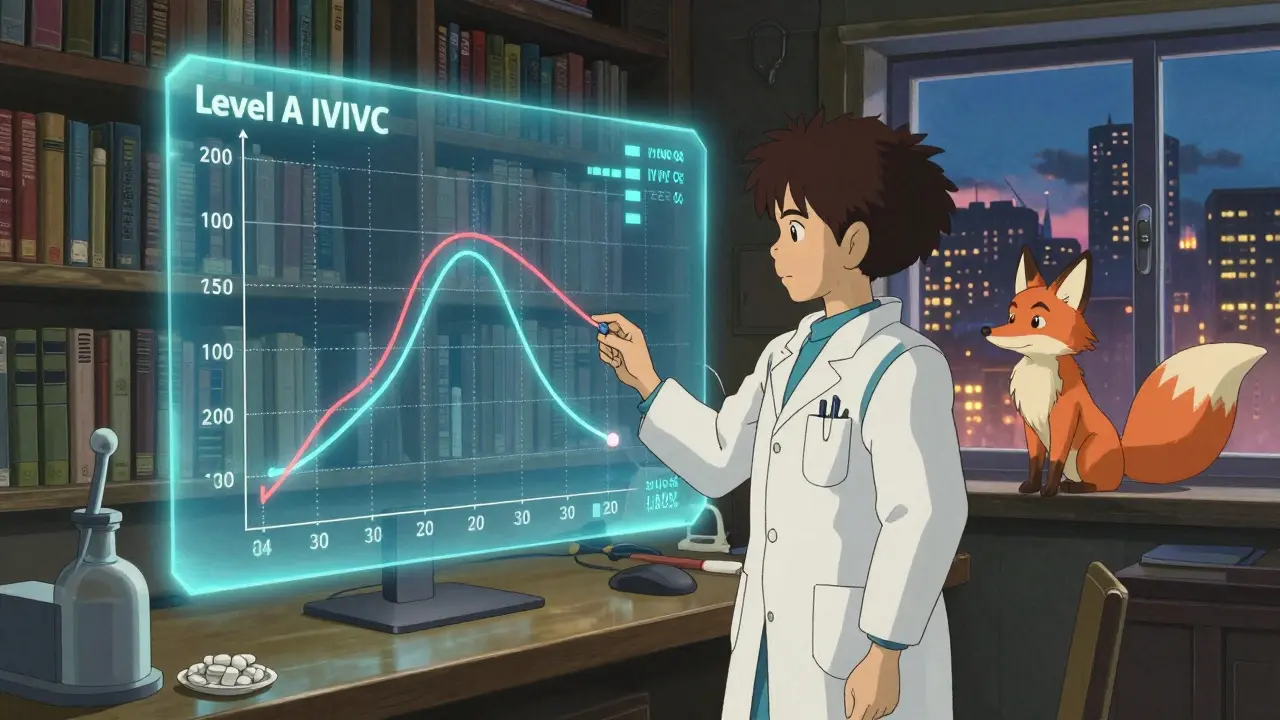
- Level A is the gold standard. It’s a point-to-point match between how the drug dissolves in the lab and how it’s absorbed in the body. If you plot the dissolution curve against the blood concentration curve, they should line up almost perfectly-R² above 0.95, slope near 1.0, intercept near zero. This level can predict the full pharmacokinetic profile. It’s rare, hard to build, but when it works, regulators accept it for full biowaivers.
- Level B uses averages. Instead of matching every data point, it compares the average time it takes for the drug to dissolve with the average time it stays in the body. It’s less precise than Level A but still useful for some applications.
- Level C is a single-point correlation. For example, if 70% of the drug dissolves in one hour, and that reliably predicts the peak blood level (Cmax), you’ve got a Level C correlation. It’s easier to develop but only predicts one parameter. Multiple Level C correlations-linking several dissolution time points to multiple pharmacokinetic values-can be accepted with extra evidence.
- Level D is the weakest. It’s just a rough guess with no mathematical model. Regulators don’t accept this for waivers.
For a biowaiver to be approved, the model must predict AUC (total exposure) within ±10% and Cmax (peak concentration) within ±15%. That’s strict. And it’s why most submissions fail.
Why Most IVIVC Submissions Fail
Between 2018 and 2022, FDA approval rates for IVIVC rose from 15% to 42%. That’s progress-but still means more than half get rejected. Why?
The biggest reason? Poorly designed dissolution tests. If your lab test doesn’t reflect what happens in the human gut, the model is useless. Traditional dissolution methods use simple buffers at pH 6.8. But real stomachs have bile salts, enzymes, and shifting pH levels. That’s where biorelevant dissolution comes in. It mimics real physiology. For example, testing in fasted-state simulated intestinal fluid (FaSSIF) or fed-state (FeSSIF) gives much better predictions. A 2019 University of Maryland study showed biorelevant methods improved correlation accuracy by up to 40% for complex extended-release formulations.
Another common failure: not testing enough formulations. You can’t build a reliable model if you only test two versions of the drug. Regulators want at least three different release profiles-fast, medium, slow-to show the model works across the spectrum. A 2022 survey of 47 generic drug companies found that 76% of failed IVIVC submissions lacked sufficient formulation variation.
And then there’s the data. You need dense pharmacokinetic sampling-12 or more blood time points per subject-and multiple studies with 12-24 volunteers each. Many companies underestimate the scale of data needed. One Reddit user from a small generic firm said their team spent $1.2 million over 18 months and still couldn’t validate the model because food effects messed up the absorption curve.
When IVIVC Works Best (And When It Doesn’t)
IVIVC shines for complex modified-release products-extended-release tablets, capsules, or pellets where timing matters. For these, the Biopharmaceutics Classification System (BCS) doesn’t help. BCS works for simple immediate-release drugs that are highly soluble and highly permeable (Class I). But if your drug is poorly soluble or has erratic absorption, IVIVC is your only path to a waiver.
Take extended-release oxycodone. Teva spent 14 months and three formulation tries to build a Level A IVIVC. But once they got it approved, they avoided five full bioequivalence studies for future manufacturing changes. That’s a clear win.
But IVIVC fails for drugs with narrow therapeutic windows-like warfarin or digoxin-where even tiny differences in absorption can cause toxicity or inefficacy. It also struggles with non-linear pharmacokinetics, where doubling the dose doesn’t double the blood level. In those cases, regulators still require human testing.
And don’t expect IVIVC to work for injectables or eye drops yet. Approval rates are low: only 32% for complex injectables and 19% for ophthalmic products. The FDA is working on new guidance for topical products, but oral delivery remains the sweet spot.
The Rise of Biorelevant Testing and Machine Learning
Industry is catching up. Biorelevant dissolution testing is no longer a niche technique-it’s becoming standard. The American Association of Pharmaceutical Scientists predicts that by 2025, 75% of new IVIVC submissions will use biorelevant media. That’s up from under 30% just five years ago.
Even more exciting? Machine learning. In 2024, the FDA and EMA held a joint workshop on AI-enhanced IVIVC models. Companies like Alturas Analytics and Pion are training algorithms to predict absorption patterns from dissolution data, reducing development time by 30-50%. These models don’t replace science-they enhance it. They help spot hidden patterns in data that humans might miss.
But here’s the catch: regulators demand transparency. You can’t just feed data into a black-box AI and call it a day. You must explain how the model works, what variables it uses, and how it was validated. The FDA’s 2023 review of 127 submissions found that 28% were rejected because the validation method was unclear.
Who’s Doing It Right?
Only five of the top ten generic drugmakers have dedicated IVIVC teams: Teva, Mylan, Sandoz, Sun Pharma, and Lupin. Why? Because it takes expertise. You need pharmacokinetic scientists, formulation chemists, and data modelers working together. Most small companies outsource to CROs like Alturas Analytics, which report success rates of 60-70% when brought in early-compared to 30-40% when companies try it alone.
The FDA’s GDUFA III funding includes $15 million for IVIVC research through 2027. That’s a signal: regulators believe this is the future. And McKinsey & Company projects that by 2027, IVIVC-supported waivers will account for 35-40% of all modified-release generic approvals-up from 22% in 2022.
What This Means for You
If you’re a patient, this means faster access to cheaper generics. If you’re a pharmacist, you’ll see more complex generics hit the market without delays. If you’re in pharma, the message is clear: invest in dissolution science. Don’t just follow USP methods. Learn biorelevant media. Understand pharmacokinetics. Partner with experts.
IVIVC isn’t easy. But it’s the most powerful tool we have to make generic drug development faster, cheaper, and smarter. The days of running dozens of human trials for every small formulation tweak are ending. The future belongs to those who can predict in vivo behavior from a lab test-and do it right.
What is an IVIVC biowaiver?
An IVIVC biowaiver is a regulatory approval that allows a generic drug manufacturer to skip human bioequivalence studies by using a scientifically validated model that predicts how the drug behaves in the body based on laboratory dissolution tests. This is accepted by the FDA and EMA when a Level A or robust multiple Level C correlation is demonstrated.
Can IVIVC be used for all types of drugs?
No. IVIVC works best for oral extended-release products where dissolution controls absorption. It’s not accepted for drugs with narrow therapeutic indexes (like warfarin), non-linear pharmacokinetics, or complex delivery systems like injectables and eye drops-yet. The FDA is exploring IVIVC for topical products, but oral delivery remains the primary application.
Why do most IVIVC submissions get rejected?
The top reasons are: 1) dissolution tests don’t mimic real stomach conditions (lack of biorelevant media), 2) insufficient formulation variation (not enough different release profiles tested), and 3) poor model validation (not enough data or unclear methods). Over 60% of rejections are due to inadequate physiological relevance.
How long does it take to develop an IVIVC model?
A full Level A IVIVC typically takes 12-18 months. That includes 3-6 months to develop a discriminatory dissolution method, 6-9 months to run pharmacokinetic studies with multiple formulations, and 3-6 months to build and validate the mathematical model. It’s a long process, but it saves months-or years-of later testing.
Is IVIVC cheaper than running human bioequivalence studies?
Yes, but only if you succeed. Building an IVIVC costs $500,000-$1.5 million upfront. But each avoided human bioequivalence study saves $1-2 million. Companies that get it right save millions over time. Those that fail waste money and time. Success depends on early planning and expert collaboration.
What’s the future of IVIVC?
The future is biorelevant testing and AI-driven models. By 2025, most new IVIVC submissions will use simulated intestinal fluids instead of simple buffers. Machine learning will help predict absorption patterns faster and more accurately. Regulators are already open to these advances-as long as the science is transparent and reproducible. IVIVC will become the norm, not the exception, for complex generics.




8 Comments
Evan Smith- 8 January 2026
So let me get this straight-we’re replacing human trials with beakers and math? I mean, I get it, but my grandma’s pills still make her feel weird sometimes. Hope this ‘Level A’ stuff actually works better than my last generic.
Annette Robinson-10 January 2026
This is actually one of the most important shifts in generic drug development I’ve seen in my career. The science behind IVIVC isn’t flashy, but it’s rigorous-and it’s saving lives by getting life-saving medications to people faster. The FDA’s standards are strict for a reason: patient safety isn’t negotiable. Kudos to the teams pushing this forward with biorelevant media and real-world data.
Lois Li-12 January 2026
Man I wish I’d known about this before I spent 18 months on a failed submission. We used plain buffer, didn’t test enough variants, and thought our dissolution curve looked ‘good enough.’ Turns out, stomachs don’t live in pH 6.8 bubbles. Biorelevant media changed everything for us once we switched. Also, don’t skip the 12+ time points. You’ll regret it.
christy lianto-13 January 2026
Stop pretending this is easy. I’ve seen companies burn $1.2 million and still get rejected because they didn’t account for food effects. IVIVC isn’t a shortcut-it’s a marathon with a finish line that moves. If you’re not working with pharmacokinetic experts from day one, you’re just throwing money at a black box.
Manish Kumar-14 January 2026
Think about it-human trials are essentially a ritual. We sacrifice volunteers to measure blood, as if the body were a black box we must crack open with needles and tubes. But IVIVC? It’s the philosophical triumph of reductionism over empiricism. We no longer need to observe the storm-we’ve learned to predict its shape from the wind’s whisper in the lab. The body is not a mystery. It is a differential equation waiting to be solved. And we are the poets of dissolution curves.
Aubrey Mallory-15 January 2026
And yet, the same companies that cut corners on dissolution testing still expect regulators to trust them with public health. It’s not just about science-it’s about accountability. If you’re not using biorelevant media, you’re not doing IVIVC. You’re doing wishful thinking with a fancy name. Stop wasting everyone’s time.
Donny Airlangga-17 January 2026
Great breakdown. I especially liked the part about Level C correlations being acceptable in multiples. That’s something I didn’t realize until I saw a recent FDA guidance update. Also, the point about AI needing transparency? Spot on. Black-box models might look cool in a PowerPoint, but regulators need to see the math, not just the results.
Molly Silvernale-18 January 2026
IVIVC is the quiet revolution nobody talks about-like the invisible scaffolding holding up the entire generic drug industry. One day, kids will learn about this in pharmacology class the way we learned about penicillin. Not because it was loud or flashy, but because it quietly saved millions from waiting, from paying too much, from dying because the system was too slow. And the real heroes? The lab techs running dissolution tests at 2 a.m. while their bosses sleep. They’re the unsung architects of access.