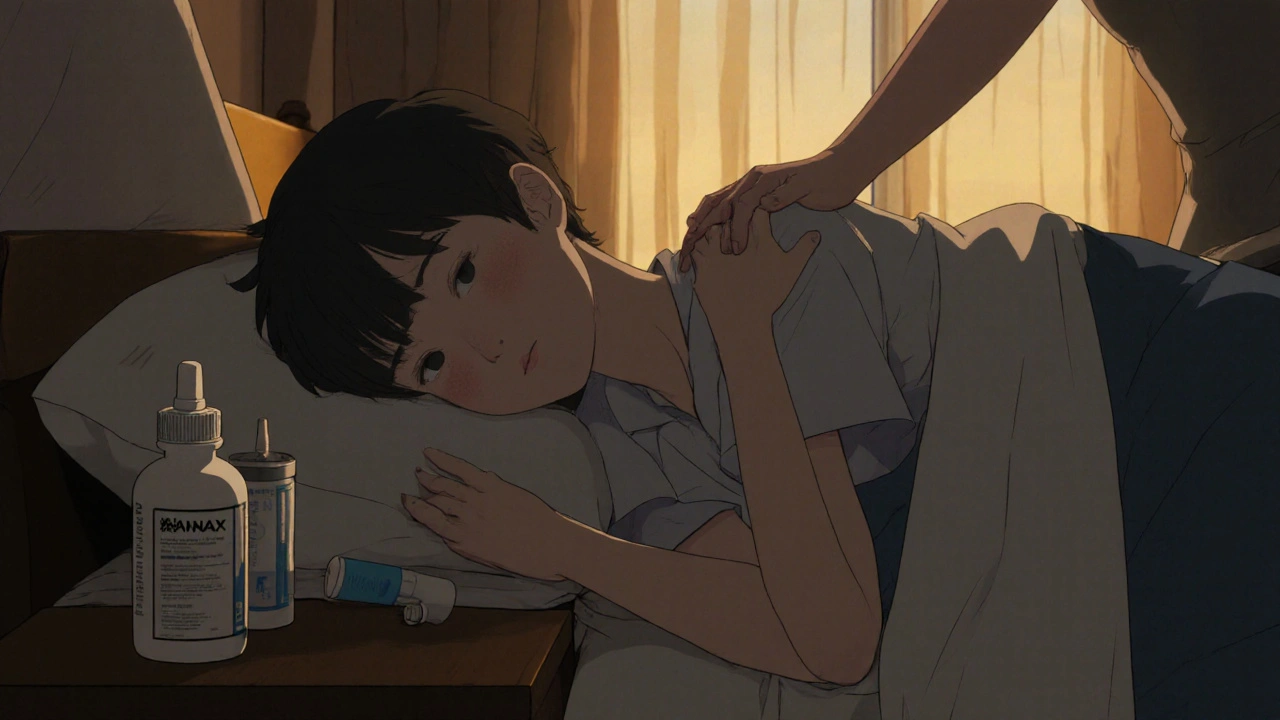
Opioid Overdose Response Guide
Identify Overdose Signs
Select all symptoms you observe in the person:
Naloxone Administration
Administer naloxone immediately if available:
- Insert nasal spray into one nostril and press firmly
- Move person to recovery position on their side
- Stay with them until emergency help arrives
Every day, 187 people in the U.S. die from a drug overdose. Most of them? Opioid overdoses. And the scary part? Many of these deaths happen because someone nearby didn’t know what to do. Not because they were cold or uncaring - but because they didn’t recognize the signs or didn’t know naloxone could bring someone back.
If you’ve ever worried about a friend using pain pills, or seen someone nodding off after using drugs, or even just heard about fentanyl being mixed into pills you thought were safe - this isn’t theoretical. It’s real. And you can learn what to do before it’s too late.
What Happens During an Opioid Overdose?
Opioids - whether it’s prescription painkillers like oxycodone, illegal heroin, or synthetic fentanyl - work by slowing down your brain’s breathing signals. That’s why they help with pain. But when too much gets into the system, those signals shut off completely.
Your lungs stop working. Oxygen drops. Brain cells start dying after just 4 to 6 minutes without air. And if no one intervenes, death follows quickly.
This isn’t just about street drugs. People overdose on prescribed medications too - especially when they mix them with alcohol, benzodiazepines, or other depressants. And now, more than ever, fake pills sold as Xanax, Adderall, or Percocet are laced with fentanyl. You don’t have to be a regular user to be at risk.
The Three Classic Signs of an Opioid Overdose
You don’t need medical training to spot an overdose. Look for these three clear signs:
- Unresponsive - Shake the person’s shoulder, shout their name. If they don’t wake up or react at all, it’s a red flag.
- Slow, shallow, or stopped breathing - Watch their chest. Are they taking fewer than 10 breaths a minute? Or are they gasping, gurgling, or making snoring sounds? That’s not sleep - that’s suffocation.
- Pinpoint pupils - Shine a light in their eyes. If the black part (pupil) is tiny like a pinhead, it’s a strong indicator of opioid overdose.
Other signs include blue or gray lips and fingernails, cold/clammy skin, limp body, and choking noises. But if you see even one or two of the big three, don’t wait. Act.
And here’s something important: pinpoint pupils aren’t always there. Some people - especially those who’ve mixed drugs or have other health conditions - won’t show this sign. Don’t wait for all the symptoms. If someone is unresponsive and breathing poorly, assume it’s an overdose.
What to Do Right Now: The 3-Step Emergency Response
There’s no time for panic. There’s only time to act. Follow these three steps - no matter who you are, no matter where you are.
- Call 911 immediately. Don’t wait to see if they wake up. Don’t try to drive them yourself. Emergency responders can give advanced care and transport them to a hospital. Say clearly: “Someone has overdosed on opioids. They’re not breathing.”
- Give naloxone if you have it. Naloxone (sold as Narcan, Kloxxado, or generic brands) reverses opioid overdoses in minutes. It’s safe, simple, and doesn’t work unless opioids are present. If you’re unsure - give it anyway. It won’t hurt someone who hasn’t taken opioids.
- Stay with them until help arrives. Even if they wake up after naloxone, they can crash again. Naloxone wears off in 30 to 90 minutes. Opioids last longer. They need monitoring. Keep them on their side. Keep talking to them. Don’t let them go back to sleep.
That’s it. No fancy equipment. No waiting for permission. Just three actions that can save a life.

How to Use Naloxone: Simple Steps for Anyone
Naloxone comes in two main forms: nasal spray and injection. Most people use the nasal spray - it’s easy, no needles needed.
For nasal spray (like Narcan):
- Remove the device from its package.
- Hold it with your thumb on the bottom and two fingers on the top.
- Tilt the person’s head back slightly.
- Insert the nozzle into one nostril.
- Press the plunger firmly to spray the full dose.
- Remove the device and move them onto their side.
For injection (if you have it):
- Inject into the outer thigh (through clothing if needed).
- Use a 1 mL syringe with 0.4 mg of naloxone.
- If no response after 3 minutes, give a second dose.
You can buy naloxone without a prescription in 49 U.S. states and many parts of Australia. Pharmacies keep it behind the counter - just ask. It costs as little as $25 now, down from over $130 just a few years ago.
Keep a dose in your car, your bag, your home. If you know someone who uses opioids - give them one. Teach them how to use it. Make it normal.
What Happens After Naloxone?
Just because someone wakes up doesn’t mean they’re out of danger.
Naloxone reverses the overdose, but it doesn’t cure the problem. The person may feel sick - sweating, shaking, nauseous. That’s withdrawal. It’s uncomfortable, but not life-threatening.
They need medical care. Why? Because opioids can cause internal damage. Lungs can be injured. Organs can be stressed. And if they used fentanyl - which is 50 to 100 times stronger than heroin - they’re at high risk of re-overdosing once the naloxone wears off.
After the emergency, encourage them to talk to a doctor. Ask about treatment options like methadone, buprenorphine, or counseling. Recovery isn’t just about quitting - it’s about rebuilding.
And if you’re the one who gave naloxone? You’re not alone. Reach out. It’s okay to feel shaken. You just did something brave.
Why This Matters Right Now
Fentanyl is everywhere. It’s in pills. In powder. In fake prescriptions. People don’t know they’re taking it until it’s too late.
In Pennsylvania, opioid overdoses are the #1 cause of accidental death. In Ohio, in West Virginia, in Michigan - same story. And it’s not just America. Australia has seen a sharp rise in synthetic opioid deaths since 2020.
But here’s the good news: communities that train people to use naloxone see 14% fewer overdose deaths. Every time someone learns how to respond, lives are saved.
You don’t need to be a nurse. You don’t need to be a first responder. You just need to know what to look for - and what to do.
Other Tools That Help: Fentanyl Test Strips
One way to reduce risk is checking drugs before using them. Fentanyl test strips cost less than $1 each. You dissolve a small amount of powder or crush a pill in water, dip the strip, and wait 5 minutes.
If it shows fentanyl - don’t use it. Or if you do, use with someone else present, have naloxone ready, and start with a tiny amount.
They’re not perfect. But they’re better than nothing. And they’re legal in most places.
Final Thought: You Can Be the Reason Someone Lives
Most opioid overdoses happen in private. At home. In a car. In a bathroom. No one sees it. No one knows.
But if you’re reading this, you’re already different. You’re not ignoring it. You’re learning. And that means the next time someone stops breathing - you won’t freeze.
You’ll call 911. You’ll give naloxone. You’ll stay with them.
That’s all it takes. No heroics. Just action.
10 Comments
Suzanne Mollaneda Padin-30 November 2025
Naloxone access has improved dramatically since 2018, but distribution is still uneven in rural areas. Many pharmacies still make you jump through hoops-even though it’s legal over-the-counter in 49 states. Community health workers in Appalachia have started handing out kits with QR codes linking to video tutorials. Simple, low-cost, effective. If you’re reading this and have a spare dose, give it to someone who might need it. It’s not a favor. It’s basic human infrastructure now.
Karandeep Singh- 1 December 2025
fake pills kill u dont need to be addict just buy one for pain u dead
Alexander Williams- 2 December 2025
The clinical framing here is statistically valid but epistemologically reductive. Opioid mortality is not a pharmacological failure-it’s a symptom of neoliberal disinvestment in social determinants of health. The emphasis on naloxone as a primary intervention naturalizes the structural violence that produces addiction in the first place. Harm reduction is necessary, but it’s not sufficient. We’re treating symptoms while the system continues to generate pathology. The real intervention is universal housing, trauma-informed care, and decriminalization-not more nasal sprays.
Kenny Leow- 3 December 2025
Just got my first Narcan kit from the pharmacy today. $18. No questions asked. The pharmacist smiled and said, 'You never know when you'll need it.' I almost cried. We need more of this. Not more laws. More kindness. And more kits in every car, every dorm, every home. 🙏
James Allen- 4 December 2025
Why are we letting drug dealers kill Americans with fentanyl-laced pills? This isn’t a public health issue-it’s a border security failure. We’re spending billions on naloxone while China and Mexico flood our streets with synthetic opioids. Someone needs to shut this down. Not just hand out sprays and call it a day. We need to win this war.
Kelly Essenpreis- 5 December 2025
all this naloxone stuff is just enabling people to keep using why not just let them die they chose this
elizabeth muzichuk- 6 December 2025
Who is funding these fentanyl test strips? Who benefits from normalizing drug use? The pharmaceutical-industrial complex wants you dependent. The government wants you docile. Naloxone is a bandage on a bullet wound. They don’t want you healed-they want you managed. Wake up. This is social engineering disguised as compassion.
Scotia Corley- 7 December 2025
While the procedural guidance is technically accurate, the underlying assumption-that laypersons are competent to manage opioid overdoses without clinical oversight-is dangerously misplaced. The absence of respiratory monitoring, cardiac surveillance, and post-reversal tox screening renders this protocol incomplete. Emergency medical services exist for a reason. Relying on lay intervention as a primary strategy constitutes a systemic dereliction of duty.
Debbie Naquin- 8 December 2025
What if the real question isn’t how to reverse overdoses but why we’ve created a society where chemical escape is the most accessible form of relief? The opioid crisis is the symptom. The disease is loneliness, economic precarity, and the collapse of communal meaning. Naloxone saves lives, yes-but it doesn’t heal the wound that made the overdose inevitable. We’re treating the ghost, not the house it haunts.
Mary Ngo- 9 December 2025
Let me tell you something no one else will. The reason fentanyl is everywhere isn’t just because of cartels. It’s because the DEA and FDA have been suppressing safer alternatives for decades-like pharmaceutical-grade heroin programs in Europe. We criminalize addiction, then act shocked when people die. This isn’t a crisis of drugs. It’s a crisis of control. We’ve chosen punishment over care. And now we’re surprised when people are dying in bathrooms. You can’t moralize someone out of withdrawal. You can only hold their hand while they breathe again.