
Medication-Supplement Interaction Checker
Select Your Medication Category
Why a Natural Remedy Could Break Your HIV Treatment
You might reach for a bottle of St. John's Wort when you feel down, seeing it as a safe, natural way to lift your mood. If you are taking HIV medication, specifically Protease Inhibitors, essential medications used to suppress the HIV virus, that decision could have catastrophic consequences. We often hear warnings about mixing alcohol or certain foods with prescription drugs, but herbal supplements hide in plain sight. They sit on the same shelf, carry different packaging, and lack the rigorous testing protocols that pharmaceutical companies must follow. Yet, for anyone managing HIV, the combination of these two substances is one of the most documented and dangerous interactions in clinical practice.
The result isn't just a minor side effect. It is complete therapeutic failure. This means your medication stops working, your viral load climbs, and worse, the virus develops resistance to the entire class of drugs you rely on. The science behind this is specific and mechanical. It's not guesswork; it is a documented biological event where one compound aggressively accelerates the breakdown of the other. By understanding exactly how St. John's WortHypericum perforatum disrupts your treatment plan, you gain the power to protect your health.
The Biology of the Breakdown
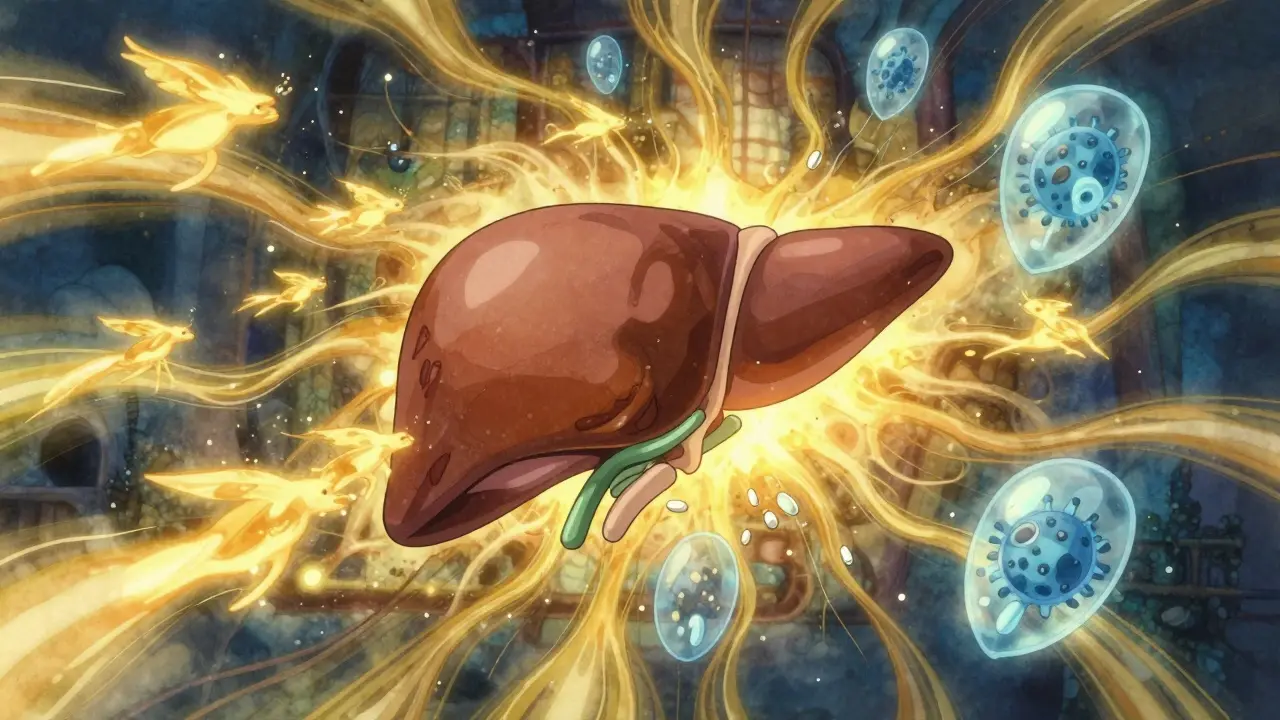
To understand why this happens, we need to look at what actually occurs inside your liver. Protease Inhibitors work by blocking the virus from replicating, but they have a very specific requirement to stay active in your bloodstream for a set period. Your body naturally tries to eliminate foreign substances using enzymes, acting like cleanup crews. One of the primary cleanup tools is an enzyme system known as Cytochrome P450 3A4Abbreviated as CYP3A4, a major enzyme family involved in metabolizing many drugs.
Normally, your liver produces a balanced amount of CYP3A4 to process medicines. It works hard enough to remove the drug eventually but slow enough to maintain effective levels in your blood. St. John's Wort throws a wrench into this gear system. Inside the herb, there is a chemical called Hyperforin. When you ingest standard doses of the herb, hyperforin acts like a supercharger for that cleanup enzyme. It tells your liver to produce exponentially more CYP3A4 than normal.
Once that enzyme system kicks into overdrive, it doesn't distinguish between 'good' toxins and 'bad' toxins-it processes everything in its path. Consequently, the Protease Inhibitor circulating in your blood gets swept away and destroyed far too quickly. Instead of staying in your system to fight the virus, the drug is metabolized before it can do any work. Think of it like trying to fill a bucket with a massive hole in the bottom; no matter how fast you pour water in, the level never rises.
The Data: How Much Protection Do You Lose?
We know the mechanism, but we need to talk numbers to grasp the scale of the risk. Clinical studies haven't left this to chance. In a landmark open-label study published around the turn of the millennium, researchers observed volunteers taking standard doses of St. John's Wort alongside indinavir, a common Protease Inhibitor. The results were stark. Plasma concentrations of the medication dropped by nearly 60 percent. More concerning, the peak concentration of the drug fell by 81 percent.
This matters because antiretrovirals need to maintain a specific threshold concentration to keep the virus suppressed. If the drug level dips below that line, even briefly, the virus finds room to replicate. Research from the University of Liverpool's HIV Drug Interactions database, updated as recently as late 2025, confirms that plasma concentrations can decrease by up to 57 percent in patients. Another review published in the journal Drug Safety highlighted that standard formulations reduce the total exposure of the drug measured as area under the curve (AUC).
| Metric | Potential Reduction | Clinical Consequence |
|---|---|---|
| Peak Concentration (Cmax) | Up to 81% | Immediate loss of efficacy |
| Total Exposure (AUC) | Up to 57% | Risk of developing viral resistance |
| Treatment Outcome | Variable | Possible virologic failure |
The danger here isn't just temporary low levels. It is the development of drug resistance. HIV mutates rapidly. When drug pressure drops, resistant strains emerge. Once resistance develops, you cannot simply go back to taking the original Protease Inhibitor. The virus now knows how to survive it. This locks you out of a primary treatment option that doctors usually reserve as a powerful tool in the arsenal.
Timing Matters: The Danger of the Washout Period
A common question patients ask is whether stopping the herb immediately fixes the problem. It sounds logical, but biology doesn't work instantly. Even if you throw out your bottle of St. John's Wort today, the induction effect on your liver enzymes remains active for quite some time. The University of Liverpool's guidelines state unequivocally that the inducing effect persists for at least 14 days after cessation of treatment.
This creates a hidden window of vulnerability. Imagine you decide to take a holiday or switch supplements and stop the herb on Tuesday. You resume your HIV medication hoping everything is safe. For the next two weeks, your liver is still running that supercharged CYP3A4 mode. Your drug levels remain dangerously low, yet you might feel fine physically. This silent gap allows the virus to slip through undetected.
Furthermore, the reverse reaction is also tricky. If you start taking St. John's Wort while on stable therapy, the enzyme induction takes a few days to build up fully. During that transition, your drug levels plummet. Conversely, if you suddenly stop the herb, your drug levels can spike back to normal or even higher as the enzyme production winds down, potentially causing toxicity symptoms. Managing this requires medical supervision and waiting periods that must be strictly followed to ensure safety.
New Developments: Is There a Safe Version?
Medical science evolves, and the landscape has shifted slightly in recent years. Up until 2023, the guidance was absolute: do not mix them under any circumstances. However, researchers realized the culprit was specifically the hyperforin content within the extract. Not all brands of St. John's Wort contain the same concentration of this potent enzyme inducer. Some standardized preparations are manufactured to contain extremely low levels of hyperforin.
In 2021, significant research identified that formulations containing less than 1 mg of hyperforin per daily dose might pose substantially lower risks. The University of Liverpool's HIV Drug Interactions database noted in its 2023 and subsequent updates that co-administration may be considered if the formulation explicitly states the hyperforin content is kept below this 1 mg threshold. This represents a nuanced shift from a blanket ban to a risk-stratified approach.
However, this comes with heavy caveats. Regulatory databases, such as the FDA's Dietary Supplement Database in 2022, showed that only 37 percent of products accurately disclose their hyperforin content on the label. Most bottles sold in pharmacies and health stores list generic ingredients like "hypericin" or "standardized extract," which refers to a different marker entirely. Unless a lab report verifies the hyperforin count, assuming safety is gambling with your viral load. Until product labeling laws tighten globally, the safest bet remains avoiding the herb completely while on Protease Inhibitors.

What To Do If You Need Depression Support
Living with a chronic condition involves complex emotional challenges. It makes sense that someone would want relief for depression. But you must prioritize the stability of your HIV regimen above all else. If you are struggling with mood, speak to your infectious disease specialist before buying anything off the shelf. There are alternative antidepressants that do not interact with CYP3A4 pathways.
Medications like sertraline or citalopram are examples that are generally safer to manage alongside antiretroviral therapy. Your doctor can evaluate your specific regimen against approved options. This step ensures that treating your mental health does not accidentally compromise your physical health. Never assume a supplement is inert just because it says "natural." To the liver, chemicals from plants and chemicals from labs both require processing.
If you discover you have been using St. John's Wort, stop immediately. Contact your clinic to check your viral load and CD4 counts. Monitor your health closely for the next two weeks while your liver resets. Doctors may adjust the dose of your HIV medication temporarily based on expected changes in metabolism. Being proactive saves your future treatment options.
Frequently Asked Questions
Can I take St. John's Wort if I'm not on Protease Inhibitors?
If you are not on Protease Inhibitors, the risk is significantly lower, but caution is still advised. St. John's Wort interacts with many other drug classes, including birth control pills, immunosuppressants, and blood thinners. Always verify with your pharmacist before starting it alongside any prescription medication.
How long should I wait after stopping St. John's Wort?
You must wait at least 14 days (two weeks) after stopping St. John's Wort before relying on your normal HIV medication dosage. This allows your liver enzymes to return to baseline function. During this period, your doctor may monitor your drug levels.
Is low-hyperforin St. John's Wort available in Australia?
Availability varies widely in Australia. Many standard products do not disclose hyperforin levels. You must ask for specific laboratory analysis certificates from the manufacturer to confirm the hyperforin content is less than 1 mg per day. Most clinicians recommend avoiding the supplement altogether to prevent any risk of therapeutic failure.
What symptoms indicate my medication isn't working?
Often, early stages of therapeutic failure show no immediate physical symptoms. The only reliable indicator is a rising viral load detected via regular blood tests. Symptoms like fatigue or flu-like illness might appear later. Regular monitoring is essential if you suspect an interaction occurred.
Does this apply to other HIV medications?
While this guide focuses on Protease Inhibitors, St. John's Wort affects many other drugs processed by CYP3A4, including some integrase inhibitors and NNRTIs. Non-nucleoside Reverse Transcriptase Inhibitors are another class where levels can drop dangerously low. Always check compatibility for every pill in your regimen.



Write a comment