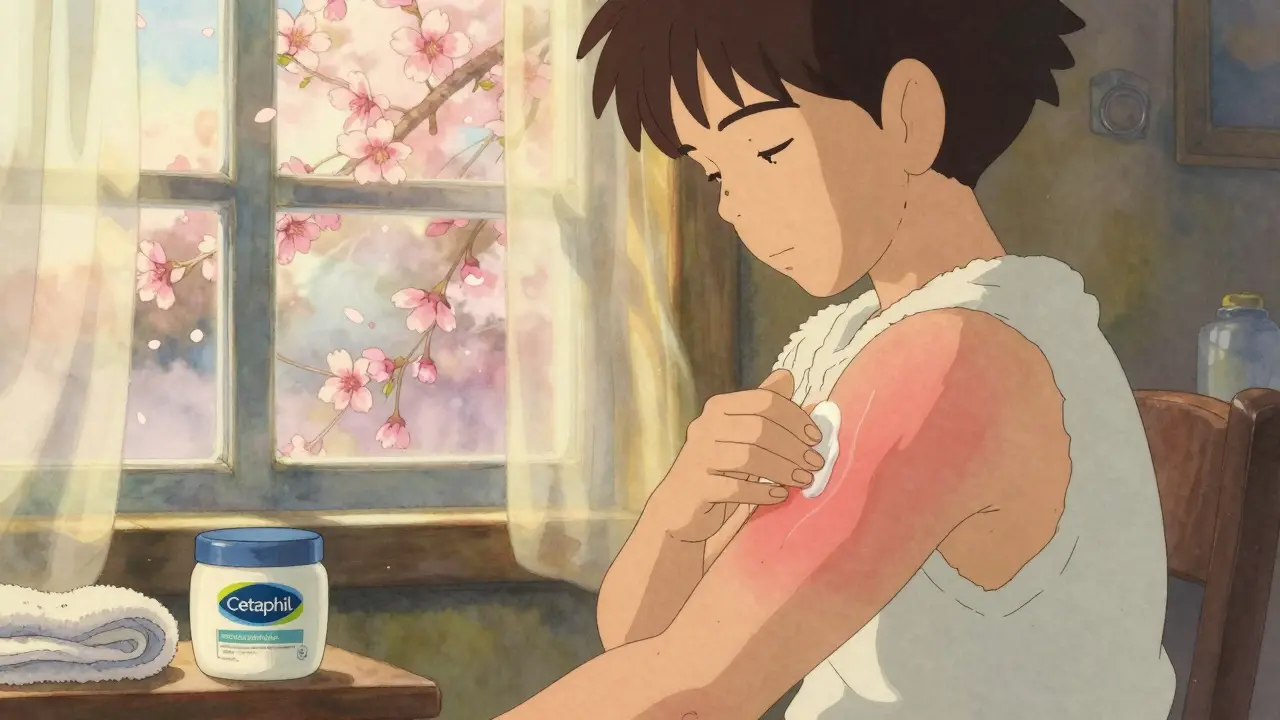
When you’re going through radiation therapy for cancer, the goal is clear: kill the cancer cells. But what no one tells you until it happens is how much your body changes along the way. Two of the most common and toughest side effects aren’t the ones you hear about in brochures - they’re the quiet, daily battles with your skin and your energy. By the time you’re halfway through treatment, your skin might feel like it’s been burned by the sun, and fatigue? It’s not just being tired. It’s exhaustion that sleep doesn’t fix.
What Happens to Your Skin During Radiation
Your skin takes the brunt of radiation therapy, especially if the treatment targets areas like the breast, head, neck, or pelvis. Around 95% of patients see some kind of reaction. It doesn’t happen all at once. It builds up. Around day 7 to 10, you might notice your skin turning red - like a mild sunburn. By week 3, it can get dry, flaky, and itchy. For some, it gets worse: the top layer of skin breaks down, oozes, and becomes painful. This is called moist desquamation, and it affects about 1 in 4 people getting radiation to the chest or head and neck. The damage comes from radiation hitting fast-dividing skin cells. Unlike cancer cells, your skin doesn’t get a break. It’s constantly regenerating, and radiation can’t tell the difference. That’s why reactions show up where the beam enters and exits the body. Modern techniques like IMRT and proton therapy help by shaping the radiation beam to avoid healthy tissue. Studies show these methods cut skin damage by 25-40%. But even with the best tech, your skin still needs care.How to Care for Your Skin During Radiation
Forget harsh soaps, hot showers, and scented lotions. Your skin is now sensitive, not just dry. Here’s what actually works:- Wash with lukewarm water - never hotter than 104°F (40°C). Use a gentle, fragrance-free cleanser like Cetaphil or Vanicream.
- Pat your skin dry. Don’t rub. Rubbing creates micro-tears that make things worse.
- Apply a moisturizer within 3 minutes of bathing. Look for products with ceramides, hyaluronic acid, or dimethicone. These help rebuild your skin’s barrier.
- Avoid deodorants, perfumes, and makeup on treated areas. Even “natural” products can irritate.
- Use a barrier film like Cavilon No Sting Barrier Film. Many patients say it prevented blisters and peeling.
- Never shave the treated area with a razor. Use electric clippers if hair removal is needed.
- Stay out of direct sun. Wear UPF 50+ clothing and a wide-brimmed hat. Radiation makes skin burn faster and scar more easily.
Why Fatigue Hits Harder Than You Expect
Fatigue isn’t just “being tired.” For 75-95% of radiation patients, it’s a constant, heavy weight. You sleep 10 hours and still feel drained. You can’t focus. You cancel plans. You feel guilty for not being able to do normal things. This isn’t in your head. Radiation triggers inflammation throughout your body. Your immune system is working overtime. Your bone marrow is slowing down red blood cell production. Your muscles are under stress. All of this drains energy. The worst part? It gets worse as treatment goes on. Most people think fatigue stays steady. It doesn’t. It creeps up. Peak fatigue usually hits between weeks 5 and 6. If you’re getting radiation to the pelvis or abdomen, it’s even worse. Studies show these patients report the highest fatigue scores.
How to Fight Radiation Fatigue
Rest won’t fix this. But movement might. The strongest evidence we have? Exercise. Not marathon training. Just walking. A 2022 study from MD Anderson found that patients who walked 30 minutes a day, five days a week, cut their fatigue by 25-30%. Resistance training twice a week helped even more. One 58-year-old breast cancer patient kept her energy levels near normal by doing light weights and daily walks. Her fatigue score was 22 points lower than others in her group. Here’s what works:- Start small. If you can only walk 10 minutes, do that. Build up slowly.
- Time it right. Exercise in the morning or early afternoon. Avoid late-day activity if it disrupts sleep.
- Listen to your body. If you’re dizzy or short of breath, stop. Don’t push through.
- Keep a sleep schedule. Go to bed and wake up at the same time every day - even weekends. No more than 20-30 minute naps.
- Hydrate. Dehydration makes fatigue worse. Aim for 8-10 cups of water daily.
- Consider modafinil. Some oncologists prescribe this off-label for severe fatigue. One patient on CancerCare’s forum saw their fatigue score drop from 72 to 58 in two weeks.
Recovery: What to Expect After Treatment Ends
Once radiation stops, your body starts healing - but not overnight. Skin reactions usually improve within 2-4 weeks. Redness fades. Peeling stops. But some changes stick around. Permanent hair loss happens if you got more than 70 Gy to the scalp. Telangiectasias - those fine red lines on the skin - show up in 30-50% of patients after five years. Skin can also thin and scar (fibrosis), especially after head and neck radiation. Hair regrowth is slow. Half of patients see regrowth by 2-3 months. But 15-20% never get full coverage back, especially if they got high doses. Fatigue lingers longer. Many patients say they feel “normal” again after 3-6 months. For some, it takes up to a year. That’s normal. Don’t compare yourself to someone who finished treatment three weeks ago.What’s New in Managing Side Effects
The field is changing fast. A 2023 study identified 12 genetic markers that predict who’s likely to get severe skin reactions. That means in the future, your care plan could be tailored to your DNA - not just your treatment plan. Apps like Mindstrong Health’s “Vitality” are now FDA-cleared. They use daily check-ins and activity tracking to help patients manage fatigue. In trials, users saw a 28% drop in fatigue scores. New topical treatments are in phase III trials. One, called ON 01910.Na, reduced moderate-to-severe skin reactions by 40% in early testing. It could be available by 2027. And tools like PRO-CTCAE - a digital system that lets patients report symptoms in real time - are now used in 45% of U.S. cancer centers. Nurses get alerts when symptoms spike, so they can step in before things get out of hand.
What No One Tells You
Most patients say they were unprepared. A 2022 survey found that 35% got little to no guidance on skin care. 28% said they had no plan for fatigue. That’s a gap in care. You need to ask for help. Request a session with a radiation oncology nurse. They can show you how to apply moisturizers, choose products, and track your symptoms. Don’t wait until your skin is cracked or you’re sleeping 16 hours a day. And remember: this isn’t weakness. It’s your body healing. The same system that’s fighting cancer is also repairing damage. Give yourself grace. Progress isn’t linear. Some days you’ll feel okay. Others, you won’t. Both are part of the process.What Products Actually Help?
Not all “radiation-safe” products are created equal. Here’s what works based on patient reports and clinical studies:- RadiaPlex Rx: A barrier cream used in 68% of surveyed patients. Helps prevent peeling.
- Biafine: Aloe-based emulsion. Soothes early redness.
- Cavilon No Sting Barrier Film: Creates a protective layer. Prevents moist desquamation.
- Hypoallergenic hydrogel dressings: For open, weeping skin. Reduces healing time by 32%.
- Cetaphil Gentle Skin Cleanser: pH-balanced. Safe for daily use.
10 Comments
Jacob Carthy-24 February 2026
This is what happens when you let big pharma control the narrative. Radiation is just a cover for something bigger. I've seen people go through this and end up worse. They're not telling you the real reason your skin breaks down. It's not just the radiation-it's the chemicals in those 'safe' creams they push on you. Cetaphil? Please. I bet it's laced with something.
Lisandra Lautert-25 February 2026
I'm not sure how anyone reads this without crying. The details are devastating. And beautiful. The way you describe fatigue as a weight-that's exactly it. Not tired. Heavy. Like gravity changed.
Cory L-26 February 2026
Walking 30 minutes a day cut fatigue by 30%? That's wild. I thought rest was the answer. Turns out movement is the secret weapon. My aunt did this and came out of it like a new person. Don't sleep your way through this. Move. Even if it's slow. Even if it's just to the mailbox.
David McKie-26 February 2026
You call this 'care'? This is just corporate sanitization dressed up as science. Hydrogel dressings? Barrier films? All of it is designed to keep you dependent on products that cost a fortune. The real solution? Stop radiation. It's not healing you. It's poisoning you slowly. They don't want you to know there are alternatives.
Joseph Cantu-26 February 2026
I read this and I just... I don't know. I'm not saying you're wrong. But I've been through this. And the truth? Nobody cares. The nurses are overworked. The doctors don't have time. The 'guidance' you're talking about? It's a brochure handed to you while you're still in the chair. And the products? Half of them are scams. I used Cavilon. It did nothing. I ended up with a wound that took six months to heal. This whole thing feels like a performance. Like we're supposed to be grateful for the crumbs.
William James-28 February 2026
I just want to say-this is important. Not because it's perfect. But because it's honest. You don't have to be strong. You don't have to 'fight'. You just have to be. And if you walk ten minutes. Or cry. Or don't shower for three days. That's okay. Your body is doing the impossible. You're not failing. You're surviving. And that's enough.
Bhaskar Anand- 2 March 2026
This is why America is falling apart. We treat cancer like a product. We give you creams and apps and step-by-step guides. But what about discipline? What about sacrifice? In my country, people don't ask for hydrogel dressings. They endure. They pray. They work. We don't need FDA-cleared apps. We need character. This post is a symptom of weakness.
lela izzani- 3 March 2026
I'm a radiation oncology nurse. I see this every day. The skin care advice here is spot-on. But what's missing? The emotional toll. The shame. The guilt of not being able to hold your child. The fear that you're not doing enough. Please-if you're reading this, reach out. Talk to someone. You're not alone. I've been there. And I'm still here.
Southern Indiana Paleontology Institute- 3 March 2026
You say radiation damages skin cells? That's not the real issue. The real issue is the radiation is designed to trigger immune response so they can sell you more drugs. I've seen the patents. The same companies that make the creams also make the machines. It's a loop. You think your skin is healing? You're just being fed more toxins. Stop believing the system. Start asking questions.
Anil bhardwaj- 5 March 2026
I just want to say thank you for writing this. My sister went through this last year. We didn't know any of this. We used Vaseline because it was cheap. It made it worse. Now I know why. This helped. Just knowing what to avoid. That's enough.