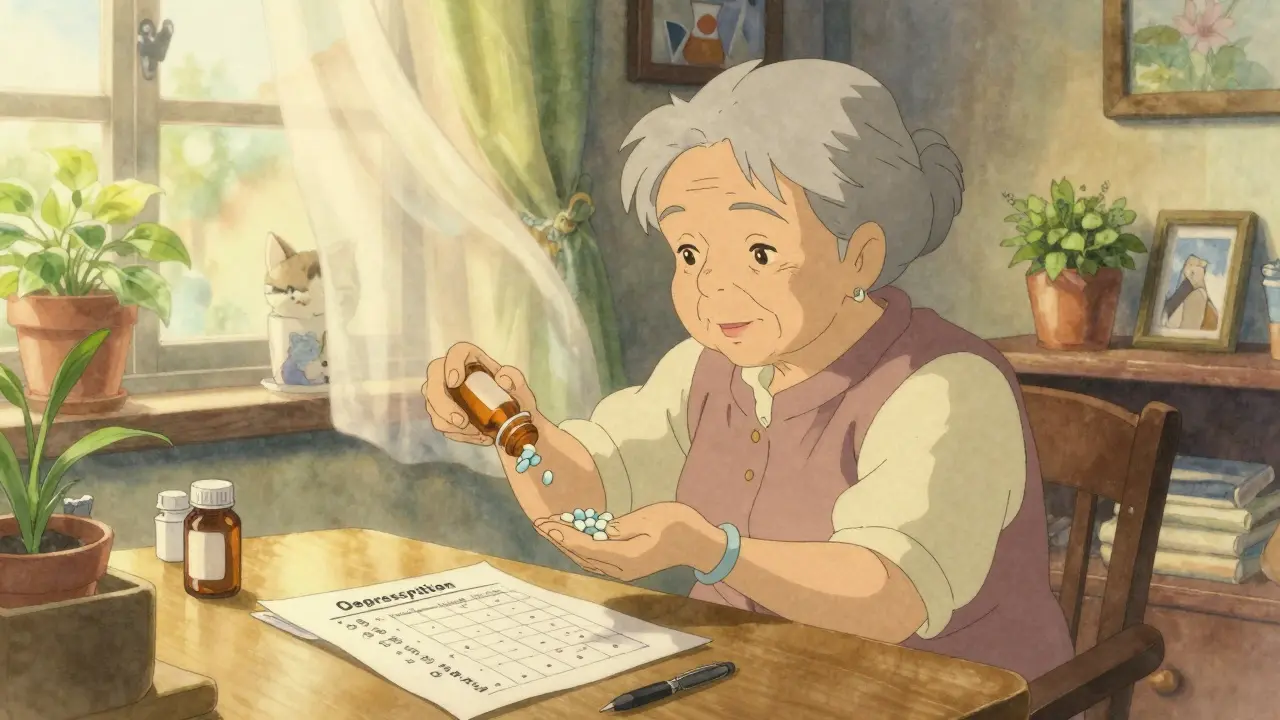
Why Reducing Medications Isn’t Just Stopping Pills
Most people assume taking more pills means better health. But for older adults on five, ten, or even fifteen medications, that belief can be dangerous. Deprescribing isn’t about cutting corners-it’s about removing drugs that no longer help, or worse, hurt. It’s the opposite of prescribing: instead of adding something new, you carefully take something away. And research shows this isn’t just theoretical. Real people, in real clinics, are getting safer and feeling better when unnecessary meds are stopped.
The Problem: Too Many Pills, Too Little Benefit
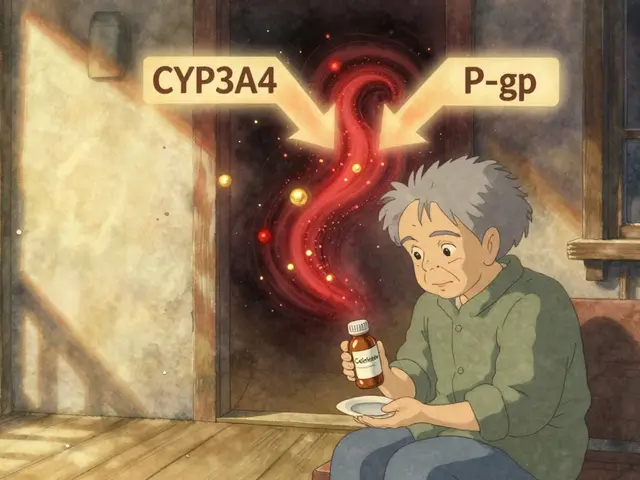
In the U.S., about 40% of adults over 65 take five or more prescription drugs. One in five take ten or more. Many of these medications were started years ago-for high blood pressure, cholesterol, acid reflux, or sleep-and never re-evaluated. The problem? As people age, their bodies change. Kidneys slow down. Liver function drops. The brain becomes more sensitive to side effects. A drug that once helped now causes dizziness, confusion, or falls. And when you stack ten drugs together, the risks multiply.
One study found that older adults on polypharmacy are twice as likely to be hospitalized for adverse drug reactions. Some of these drugs are preventive-like statins or aspirin for heart disease-but if someone has advanced dementia or a life expectancy under two years, those benefits vanish. The risks, however, stay the same. That’s why deprescribing is no longer optional. It’s a necessary part of care.
How Deprescribing Actually Works
Deprescribing isn’t a one-time decision. It’s a five-step process, done slowly and carefully:
- Identify potentially inappropriate medications. This means drugs with known risks in older adults, like benzodiazepines for sleep, proton pump inhibitors used long-term, or anticholinergics for overactive bladder.
- Determine if the drug can be stopped or reduced. Not every pill can come off. But many can. For example, a patient on a low-dose statin with no history of heart disease and a life expectancy of less than five years may not need it anymore.
- Plan a taper. Some drugs can’t be stopped cold turkey. Antidepressants, blood pressure meds, and steroids need gradual reduction to avoid withdrawal symptoms like rebound anxiety, high blood pressure, or adrenal crisis.
- Monitor closely. After stopping a drug, patients are checked weekly for the first month. Did their pain get worse? Did they sleep better? Did they fall? Did their confusion clear up?
- Document everything. What was stopped? Why? What happened? This becomes part of the medical record and helps future providers avoid restarting unnecessary meds.
This isn’t guesswork. It’s clinical protocol-same rigor as starting a new drug. And it requires teamwork: doctors, pharmacists, nurses, and patients all play a role.
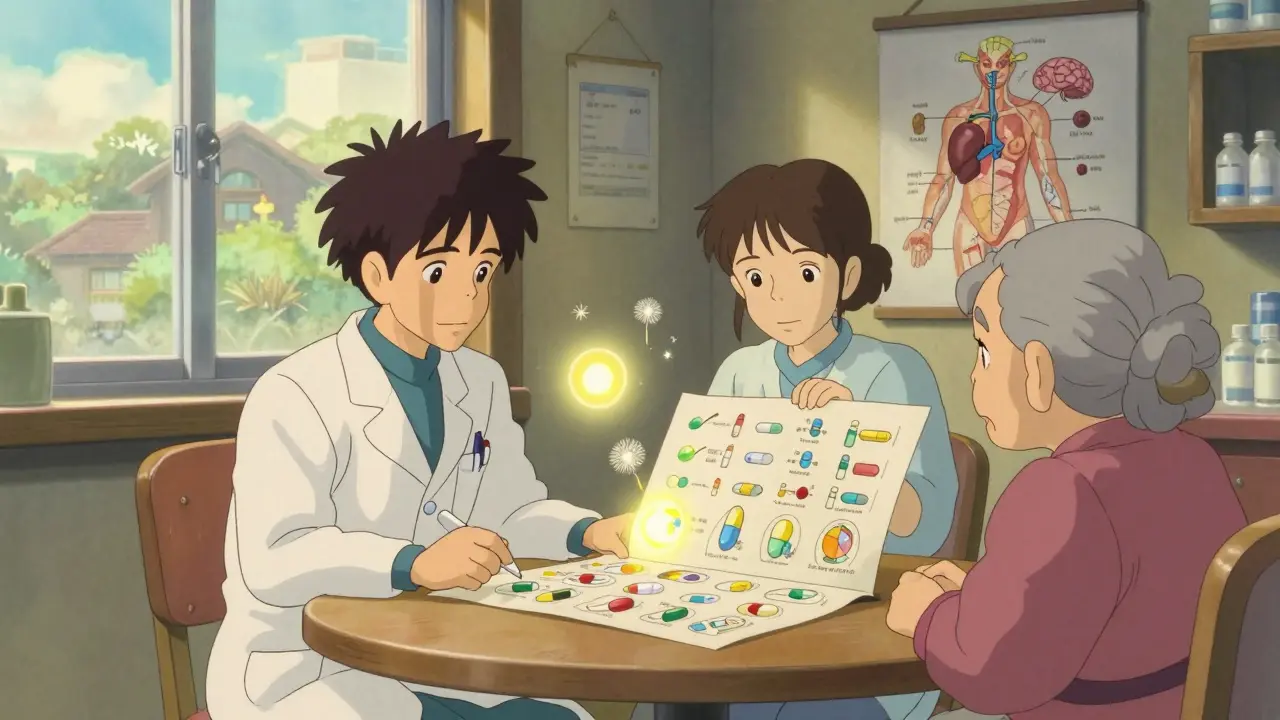
What the Research Shows: Real Outcomes, Not Just Numbers
Early studies focused on how many pills were cut. That’s easy to measure. But the real question is: did patients feel better? Did they fall less? Did they live longer?
A 2023 review in JAMA Network Open analyzed 37 trials involving over 10,000 older adults. The results? On average, deprescribing reduced the number of medications by one per person. Sounds small? Consider this: a primary care doctor with 2,000 patients, half of whom are on multiple meds, could prevent 140 unnecessary prescriptions in a year. That’s not just a number-it’s 140 fewer chances for a dangerous interaction, a fall, or an ER visit.
And the benefits go beyond pills. Studies show deprescribing leads to:
- Reduced risk of falls (by up to 30% in some trials)
- Improved mental clarity and alertness
- Fewer hospital admissions
- Higher patient satisfaction
One study followed patients who stopped long-term proton pump inhibitors (PPIs) for heartburn. Within weeks, many reported less bloating, less nausea, and better digestion. Others stopped sleeping pills and found they slept more naturally-without the grogginess that made them stumble in the morning.
The Big Gap: We Still Don’t Know Enough
Here’s the problem: most deprescribing studies last only a few months. But the effects of stopping a drug can take longer to show-or to hide. What if stopping a blood pressure pill causes a stroke six months later? What if a patient’s depression returns after stopping an antidepressant? We don’t have long-term data.
Dr. Dan Gnjidic, a leading researcher in this field, says it plainly: “We’ve shown we can reduce medications. But we haven’t yet proven, with strong evidence, that this reduces deaths or major events like heart attacks.” That’s the next frontier. Researchers are now launching multi-year trials to track outcomes like hospitalization, mobility, cognitive decline, and survival-not just pill counts.
Another blind spot? Patients with multiple doctors. If someone sees a cardiologist, a neurologist, a rheumatologist, and a primary care provider, each might prescribe something without knowing what the others ordered. That’s why coordinated care is critical. Some health systems are now using digital alerts in electronic records to flag patients on high-risk drug combinations. Early pilot programs cut inappropriate prescriptions by 15%.
Patients Want This-But They Wait for the Doctor to Start the Conversation
Here’s something surprising: most older adults would gladly take fewer pills-if they felt safe doing it. But they rarely bring it up. Why? Because they’ve been taught to trust their doctor’s prescriptions. If a pill was given to them, it must be necessary. They don’t want to seem difficult or ungrateful.
One study found that 80% of patients over 70 had never been asked if they wanted to reduce their medications. Yet when doctors asked, 70% said yes. The key? How the question is asked. Saying, “We might be able to take some of these off and help you feel better,” works far better than, “Are you ready to stop your meds?”
Resources like deprescribing.org have helped. They offer simple handouts patients can read at home: “Medications that helped before might not help now.” That’s all it takes to start the conversation.
What’s Next? Personalized Deprescribing
The future of deprescribing isn’t one-size-fits-all. It’s becoming more precise. Researchers are exploring how genetics affect drug metabolism. For example, some people break down benzodiazepines slowly-making them more prone to confusion and falls. Genetic testing could one day help identify who’s at highest risk from certain drugs.
Another promising area: AI tools that scan a patient’s entire medication list and flag the most likely candidates for reduction. One pilot program at a large U.S. clinic used an algorithm to recommend deprescribing for 120 patients. Within six months, 68% of those recommendations were followed-and only 3% needed to restart the medication due to side effects.
As the population ages, this won’t be a niche practice. By 2030, 20% of Americans will be over 65. That’s 72 million people. Most will be on multiple medications. Without deprescribing, we’ll see more falls, more confusion, more hospital stays-and higher costs.
It’s Not About Cutting Costs. It’s About Cutting Harm.
Some think deprescribing is just a way to save money. It’s not. It’s about safety. About dignity. About letting people live well, not just live longer.
Stopping a drug isn’t failure. It’s good medicine. It’s saying, “We’ve done what we can. Now let’s make sure what’s left truly helps you.”
Is deprescribing safe?
Yes, when done properly. Research shows that stopping unnecessary medications under medical supervision is safe for most older adults. The key is doing it slowly, one drug at a time, and watching closely for changes. Withdrawal symptoms can happen, but they’re rare when the process is planned. In fact, many patients report feeling better after stopping drugs that were causing dizziness, confusion, or stomach issues.
Can I stop my meds on my own?
No. Some medications, like blood pressure pills, antidepressants, or steroids, can cause serious harm if stopped suddenly. Always talk to your doctor first. They’ll help you create a safe plan to reduce or stop the right drugs at the right pace.
What if my symptoms come back after stopping a drug?
That’s why monitoring is part of the process. If a symptom returns, your doctor will evaluate whether it’s from the medication withdrawal or another cause. Sometimes, the symptom was caused by the drug itself. Other times, it’s the original condition coming back. Either way, you and your provider will decide together whether to restart the drug, try a different one, or manage it another way.
Does deprescribing mean I’m giving up on treatment?
Not at all. It’s about focusing on what still matters. For someone with advanced dementia, preventing a stroke with aspirin may not be worth the risk of a fall. For someone with limited life expectancy, taking a statin for cholesterol may not add years-but it could add nausea, muscle pain, and confusion. Deprescribing helps you keep the treatments that improve your daily life, not just extend it.
How do I start a conversation about deprescribing with my doctor?
Try saying: “I’ve been taking these pills for years, and I’m wondering if any of them are still helping-or if any might be making me feel worse.” Bring a list of everything you take, including vitamins and over-the-counter drugs. Ask: “Which ones are most likely to cause side effects in someone my age?” Most doctors welcome this conversation. You’re not challenging them-you’re partnering with them.
14 Comments
Glenda Marínez Granados-21 January 2026
So we're just gonna keep prescribing like we're playing Jenga with old people's brains? 🤦♀️ One wrong move and WHAM - they're on the floor with a hip fracture and a new cocktail of meds to 'fix' the side effects. I love how medicine treats aging like a bug to be patched, not a natural process to be respected.
MARILYN ONEILL-22 January 2026
I work in a nursing home. I've seen it. Grandmas on 12 pills. One for blood pressure. One for cholesterol. One for sleep. One for anxiety. One for acid reflux. One for arthritis. One for depression. One for... I don't even remember. And they're all just sitting there staring at the wall. The meds aren't helping. They're just making them quieter.
Steve Hesketh-23 January 2026
This is the kind of care we should be proud of. Not adding more pills to fix more problems, but having the courage to say, 'Let’s see what happens if we take some of this away.' I’ve watched older patients light up after stopping a sleeping pill or a statin they didn’t need. Their eyes get clearer. They laugh again. That’s not medicine. That’s magic. And it’s free.
Samuel Mendoza-23 January 2026
Deprescribing is just cost-cutting dressed up as compassion. You think stopping a statin won’t kill someone? Wake up. People die from heart attacks, not from side effects.
Malvina Tomja-25 January 2026
Let’s be real. If you’re over 70 and still on a statin, you’re either a cardiologist’s best friend or you’ve been asleep since 2008. The fact that this even needs a study is embarrassing. We’re treating 80-year-olds like they’re 50-year-olds with a spreadsheet.
Ben McKibbin-25 January 2026
This isn't radical. It's rational. Medicine has spent decades glorifying intervention-more drugs, more scans, more procedures. But sometimes, the most powerful thing you can do is nothing. Not because you're out of options, but because you've finally learned what matters: function, comfort, dignity. Deprescribing isn't a trend. It's a return to first principles.
Amber Lane-26 January 2026
My abuela took 8 pills a day. We asked the doctor if any could go. He said yes-three of them. Within a week, she was walking to the porch again. No more dizzy spells. No more confusion. Just her, her coffee, and her birds. Sometimes less really is more.
Ashok Sakra-28 January 2026
I can't believe people are still taking statins after 75. I mean, come on. The body is slowing down. Why force it to metabolize chemicals it can't handle? I told my cousin's mom to stop hers. She cried. Said her doctor said it would kill her. But guess what? She didn't die. She just stopped feeling like a zombie.
michelle Brownsea-29 January 2026
I'm sorry, but this is dangerous. You can't just 'take away' meds like they're candy. What about the patients who don't have family to monitor them? What about the ones who don't understand the risks? This isn't empowerment-it's negligence wrapped in a buzzword. People need structure, not experimentation.
Roisin Kelly-29 January 2026
They're all just part of the pharmaceutical conspiracy. You think these doctors actually care? Nah. They get kickbacks. Every pill they prescribe = a commission. That's why they won't stop. That's why they're scared of deprescribing. It's not about safety-it's about profit. And you're all being played.
lokesh prasanth-31 January 2026
Statins dont even work for old people. Study said so. Why keep giving? Its just waste. Doctor dont care. They just want to check box.
Yuri Hyuga- 1 February 2026
This is the future of healthcare-and I’m so proud to see it unfolding. 🌱 Imagine a world where we measure success not by how many prescriptions we write, but by how many people wake up feeling like themselves again. This isn’t just medicine. It’s humanity. Let’s keep pushing for it.
Coral Bosley- 2 February 2026
I’ve been on 11 meds for 12 years. I didn’t realize how much they were fogging me out until I stopped two of them. I cried the first morning I woke up without that chemical hangover. I remembered my daughter’s voice. I remembered what coffee tasted like. I didn’t know I’d forgotten.
Kevin Narvaes- 2 February 2026
i mean... if you stop your blood pressure med and you die... is that on the doctor? or on you? i just dont trust anyone to make these calls. too risky. just keep giving me the pills.