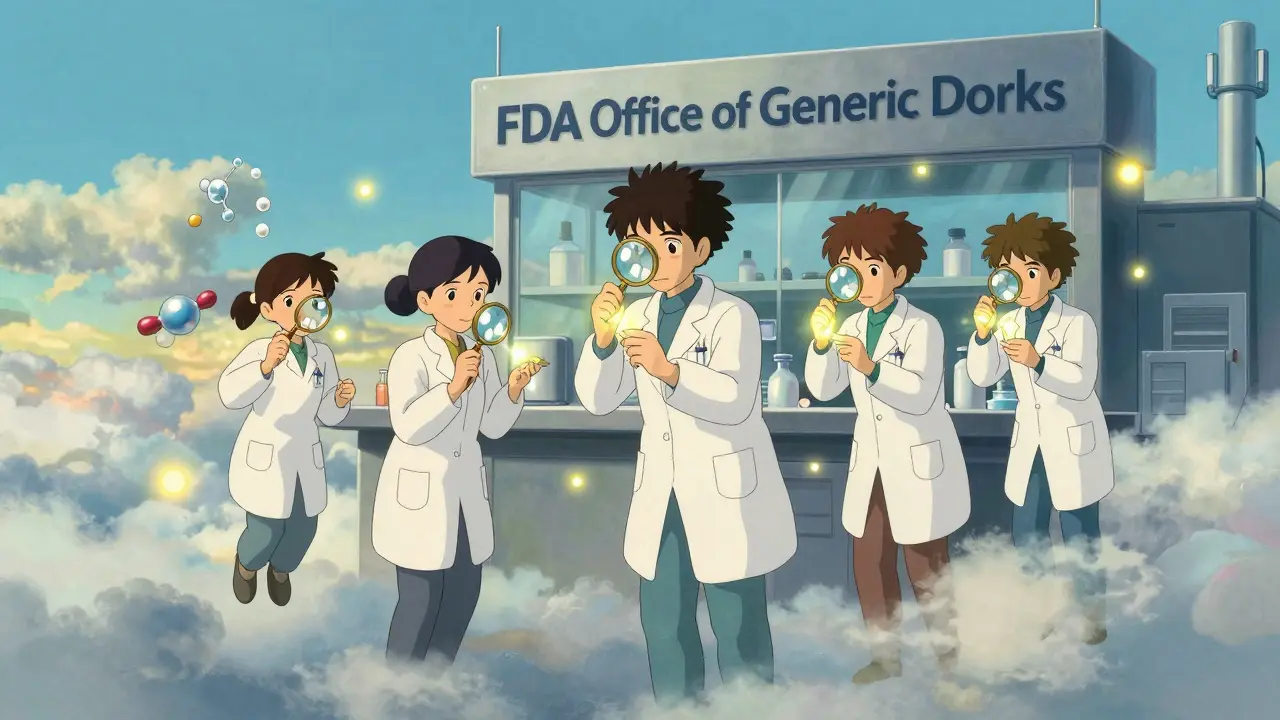
The U.S. Food and Drug Administration doesn’t just approve brand-name drugs. In fact, nearly 90% of all prescriptions filled in the U.S. are for generic drugs. Behind every one of those pills, patches, or injections is the FDA Office of Generic Drugs (OGD) - the quiet engine that keeps affordable medicines flowing to patients across the country.
Before 2013, generic drug reviews were scattered across different teams inside the FDA. Delays piled up. Backlogs grew. Patients waited longer for cheaper alternatives to expensive brand-name drugs. That changed when the FDA reorganized OGD into a standalone "super office" reporting directly to the head of the Center for Drug Evaluation and Research (CDER). The goal? Speed up approvals without cutting corners on safety.
What the FDA Office of Generic Drugs Actually Does
OGD doesn’t invent drugs. It doesn’t manufacture them. It doesn’t even prescribe them. What it does is decide whether a generic version of a brand-name drug is safe, effective, and interchangeable. That’s it.
Every generic drug must prove it’s bioequivalent to the original - meaning it delivers the same amount of active ingredient into the bloodstream at the same rate. OGD sets the standards for how that’s measured. It reviews thousands of applications every year called Abbreviated New Drug Applications, or ANDAs. These aren’t full clinical trials like brand-name drugs need. Instead, they rely on science showing the generic matches the brand in performance.
But here’s the catch: even though the process is abbreviated, the review isn’t simple. OGD scientists check everything - from the chemical structure to the coating on the pill. A generic tablet that dissolves too fast or too slow can cause side effects or fail to work. OGD’s job is to catch those issues before the drug hits pharmacy shelves.
How OGD Is Structured
OGD isn’t one big team. It’s made up of six parts, each with a clear role:
- Immediate Office (IO): The nerve center. This team leads strategy, manages budgets, handles legal advice, and coordinates global work. It includes the Division of Legal and Regulatory Support, which is the FDA’s go-to expert on the Hatch-Waxman Act - the law that lets generics enter the market after patents expire.
- Office of Bioequivalence (OB): This is where the science happens. Scientists here design and review bioequivalence studies. They decide what blood level data proves a generic is the same as the brand. They also have a safety team that watches for unexpected side effects after generics hit the market.
- Office of Generic Drug Policy: This team writes the rules. They interpret the Hatch-Waxman Act, handle patent disputes, and determine when a generic can be approved - especially if there’s exclusivity for the first company to file. They also respond to questions from Congress, the White House, and foreign regulators.
- Office of Regulatory Operations (ORO): The project managers. These folks don’t do the science, but they keep the whole review process on track. Each one oversees dozens of ANDA reviews, making sure deadlines are met, documents are complete, and teams aren’t overloaded. They also handle labeling reviews and filing checks.
- Office of Research and Standards (ORS): The innovators. This group develops new testing methods, uses modeling to predict how drugs behave in the body, and creates standards for complex generics like inhalers or injectables. They’re the reason today’s generics are more reliable than ever.
- Office of Safety and Clinical Evaluation: The watchdog. They analyze reports of adverse events linked to generic drugs. If a pattern emerges - say, a batch of generic metformin causing stomach issues - they investigate. They work with other FDA offices to update safety labels or issue warnings if needed.
This structure lets OGD handle over 1,500 ANDAs annually while staying on schedule. Thanks to the GDUFA funding system, most applications are reviewed within 10 months - sometimes faster.
The Laws That Make It All Possible
OGD doesn’t operate in a vacuum. Two laws shape everything it does.
The first is the Hatch-Waxman Act of 1984. Before this law, generic manufacturers couldn’t rely on the brand-name drug’s safety data. They had to run full trials - which cost millions and took years. Hatch-Waxman changed that. It allowed generics to use the original drug’s data, as long as they proved bioequivalence. It also gave brand companies extra patent time to make up for delays during FDA review. And it created the first-to-file incentive: the first generic company to submit an ANDA gets 180 days of market exclusivity.
The second is the Generic Drug User Fee Amendments (GDUFA). Passed in 2012 and renewed every five years, GDUFA lets generic drug makers pay fees to fund FDA reviews. Before GDUFA, the FDA was underfunded and slow. Now, with over $500 million in annual fees, OGD can hire more scientists, upgrade systems, and meet strict review timelines. It’s a win-win: manufacturers get faster approvals, and the public gets cheaper drugs sooner.
How OGD Keeps Generic Drugs Safe
One common myth is that generic drugs are "lesser" versions. That’s not true. OGD requires generics to have the same active ingredient, strength, dosage form, and route of administration as the brand. They must meet the same strict manufacturing standards - same quality controls, same inspections, same good manufacturing practices.
But safety doesn’t end at approval. OGD’s Safety and Surveillance Team tracks adverse events reported to the FDA’s MedWatch system. If a generic version of a blood thinner starts showing more bleeding cases, OGD investigates. They might ask the manufacturer to change the label, run additional tests, or even pull the product.
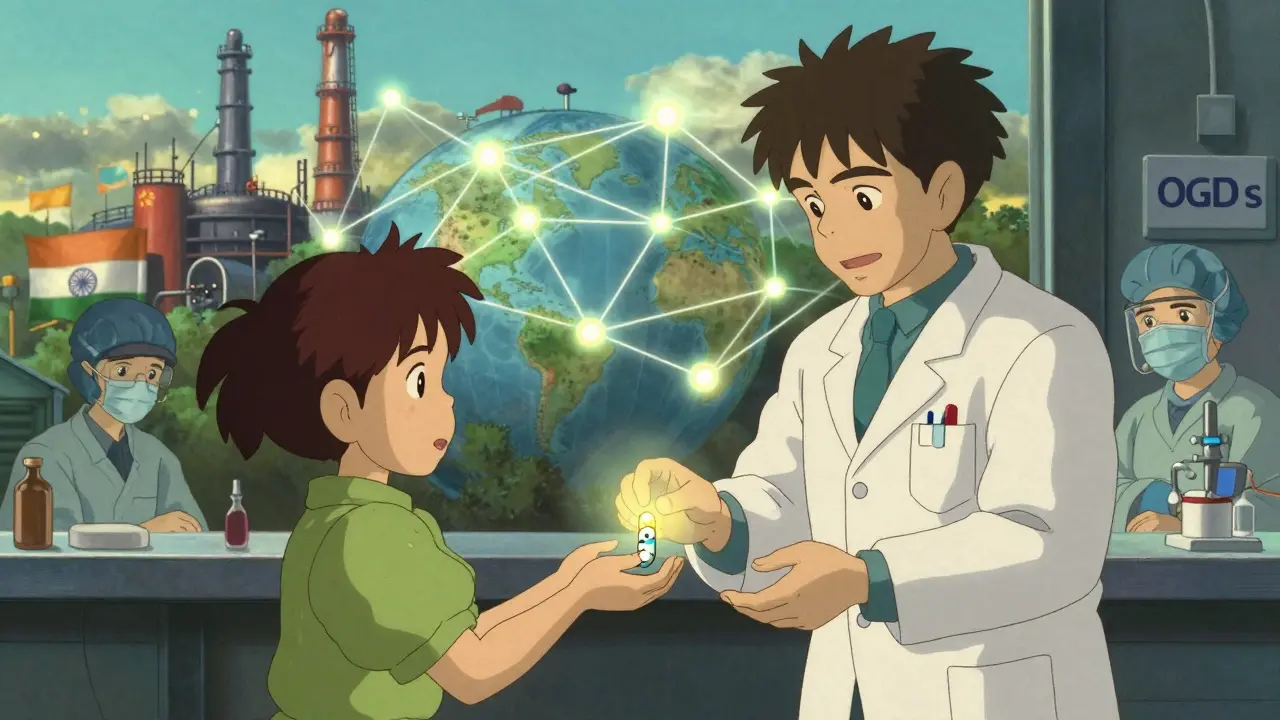
They also work with international regulators. A generic made in India and sold in the U.S. must meet the same standards as one made in New Jersey. OGD’s Global Generic Drug Affairs Team coordinates with agencies in Europe, Canada, and Japan to share data and avoid duplication. This matters because more than half of generic drug ingredients come from outside the U.S.
Why OGD Matters to You
Generic drugs save Americans over $300 billion every year. Without OGD, those savings wouldn’t happen. Imagine paying $500 for a month’s supply of lisinopril when a generic costs $4. That’s the difference OGD makes.
It’s not just about price. It’s about access. When a drug shortage hits - like insulin or antibiotics - OGD fast-tracks approval of alternative generics. When a brand-name drug loses patent protection, OGD ensures multiple generics enter the market quickly, driving prices down further.
And it’s not just patients who benefit. Pharmacies, insurers, and government programs like Medicare rely on generics to control costs. OGD’s work keeps the whole system running.
What Happens After Approval?
Approval isn’t the end. OGD keeps watching. Manufacturers must report changes - like switching suppliers or updating equipment. Even small changes can affect how a drug performs. OGD reviews those changes before they’re implemented.
If a generic drug is found to be unsafe or ineffective after approval, OGD can issue a recall. In 2018, a batch of generic valsartan was pulled after a cancer-causing impurity was found. OGD coordinated the recall and worked with global regulators to fix the issue.
OGD also updates its standards as science evolves. For example, new methods now allow testing of complex generics like nasal sprays and topical creams - things that were hard to prove equivalent just a decade ago.
Bottom line: OGD doesn’t just approve drugs. It ensures that every generic on the shelf is as good as the brand - and that millions of Americans can afford to take them.
What is the difference between a brand-name drug and a generic drug?
The only differences are the inactive ingredients - like color, flavor, or filler - and the price. Generic drugs contain the same active ingredient, strength, dosage form, and route of administration as the brand. They must meet the same FDA standards for safety, quality, and effectiveness. OGD ensures they work the same way in the body.
How long does it take for OGD to approve a generic drug?
Under GDUFA, OGD aims to complete its review of a standard ANDA within 10 months. First generics - the first to enter the market after a patent expires - often get priority review and can be approved faster. Complex drugs, like inhalers or injectables, may take longer due to additional testing requirements.
Does OGD inspect generic drug factories?
Yes. OGD works with the FDA’s Office of Regulatory Affairs to inspect manufacturing facilities worldwide. About 40% of inspections happen outside the U.S., mainly in India and China. All facilities - whether making brand or generic drugs - must meet the same Good Manufacturing Practices (GMP) standards.
Can a generic drug be pulled from the market after approval?
Yes. If post-market data shows a generic drug is unsafe, ineffective, or doesn’t meet quality standards, OGD can recommend a recall. This has happened multiple times - for example, when impurities were found in blood pressure or diabetes medications. OGD monitors adverse event reports and works with manufacturers to fix issues before they become widespread.
Why do some people say generic drugs don’t work as well?
Most of the time, that’s a myth. Generic drugs are required to be bioequivalent to the brand - meaning they deliver the same amount of medicine into your bloodstream. But sometimes, people notice differences in how a pill looks or feels. That’s because inactive ingredients change. Rarely, a patient might be sensitive to one of those fillers. If that happens, talk to your doctor or pharmacist - there’s usually another generic option available.
How does OGD handle patent disputes between brand and generic companies?
OGD doesn’t decide patent validity - that’s up to courts. But under the Hatch-Waxman Act, generic companies must certify whether they believe a patent is invalid or won’t be infringed. OGD tracks these certifications and uses them to determine when a generic can be approved. If a patent challenge is filed, OGD may delay approval until the legal issue is resolved - unless the first generic company qualifies for 180-day exclusivity.
What’s Next for OGD?
OGD is now focused on tackling harder-to-make generics - like complex injectables, biologics, and combination products. These drugs are harder to copy, but they’re also more expensive. OGD’s Research and Standards team is developing new testing tools to make sure these generics are just as safe and effective.
They’re also improving digital tools for manufacturers to submit applications faster and reducing paperwork. More data sharing with international regulators means fewer redundant reviews and quicker global access.
As more drugs lose patent protection in the next few years - including high-cost biologics - OGD’s role will only grow. The goal remains simple: make sure no one has to choose between their health and their wallet.

12 Comments
Andrew Short-18 January 2026
Let’s be real - this whole OGD system is a glorified paper-pushing operation that lets foreign factories cut corners while the FDA pretends to watch. You think they inspect every plant in India? Ha. Half those generics are just repackaged chemical soup with a FDA sticker slapped on. And don’t get me started on the 180-day exclusivity loophole - it’s a corporate giveaway disguised as competition.
Patients think they’re saving money? Nah. They’re getting substandard crap that makes them sick, and then they blame their bodies instead of the system. I’ve seen it firsthand - my cousin’s generic metformin gave him constant diarrhea while the brand didn’t. Coincidence? I think not.
Robert Cassidy-20 January 2026
They call it ‘bioequivalence’ like it’s some sacred scientific truth. But what if the body doesn’t care about blood levels? What if it cares about the soul of the medicine? The pill is the same, sure - but the energy? The intention? The spirit of the original brand? That’s lost in translation.
We’ve turned healthcare into a spreadsheet. A number on a graph. A line item in a budget. And we wonder why people feel hollow when they take their meds. The FDA doesn’t measure heart. It measures absorption rates. And that’s why we’re all so damn sick - not just physically, but spiritually.
Dayanara Villafuerte-21 January 2026
Okay but can we talk about how OGD is basically the unsung hero of American healthcare? 🙌 Like, no one talks about them but they’re the reason your $4 insulin exists. 🤯
OGD scientists are out here coding new algorithms to test inhalers while Congress argues about TikTok bans. And you know what? They’re not even famous. No documentaries. No Netflix specials. Just quiet, brilliant people making sure your grandma’s blood pressure med doesn’t turn into a brick.
Respect. 🫡
Andrew Qu-22 January 2026
For anyone worried about generics - don’t be. The science is rock solid. OGD doesn’t cut corners; they streamline. They use smarter methods now - modeling, predictive analytics, real-world data. The days of ‘generic = weak’ are over.
I’ve worked in pharma for 15 years. I’ve seen brand-name companies fight generics with lawsuits and PR campaigns. But the data doesn’t lie: generics work. They save lives. And they’re held to the same exacting standards as the originals.
If your doctor says it’s safe, trust them. If your pharmacist says it’s equivalent, trust them. The system works - if you let it.
Danny Gray-23 January 2026
Interesting how they frame GDUFA as a ‘win-win’ - as if the industry didn’t design it to funnel billions into their pockets while outsourcing labor to countries with lax oversight. Who really benefits here? The patient? Or the shareholder?
And let’s not pretend the Hatch-Waxman Act was some altruistic breakthrough. It was a deal struck between Big Pharma and generic manufacturers to delay competition while pretending to promote access. The 180-day exclusivity? That’s not innovation - that’s collusion with a side of regulatory theater.
OGD doesn’t protect patients. It protects the illusion of choice.
Tyler Myers-24 January 2026
You think this is about safety? Nah. This is about control. The FDA, WHO, and Big Pharma are all in bed together. They let cheap generics in - but only after they’ve been contaminated with microchips or lithium salts to track your compliance. You think they care if your blood pressure drops? They care if you’re *obedient*.
They’re using your meds to build a database. Every pill you take is logged. Every refill. Every adverse event. They’re mapping your biology to predict behavior. And OGD? It’s the front door. The gateway drug to the surveillance state.
Next thing you know, your insulin will come with a subscription fee. And if you don’t pay? Your pump shuts off.
Zoe Brooks-25 January 2026
Honestly, this post made me feel so much better about the system. I used to be scared of generics because they looked different - smaller, weird colors, different shape. But now I get it: it’s just the filler. The medicine inside? Same thing.
My dad’s on a generic statin and his cholesterol’s down. No side effects. No drama. Just… works. That’s all we need.
People forget: medicine isn’t about branding. It’s about healing. And OGD? They’re quietly doing the hard work so we don’t have to choose between health and rent.
Kristin Dailey-25 January 2026
Foreign factories. 40% inspections. Good luck.
Wendy Claughton-27 January 2026
I just want to say… thank you to everyone at OGD. 🌿
I know you don’t get applause. You don’t get headlines. You don’t get to be on TV. But you’re the reason my daughter can take her ADHD meds without us going bankrupt. You’re the reason my mom can afford her heart pills. You’re the reason people like me - who aren’t rich, who aren’t powerful - still get to live.
Thank you for being the quiet ones who make sure the system doesn’t break. You matter more than you know.
Stacey Marsengill-28 January 2026
They say generics are ‘just as good.’ But what if ‘just as good’ is a lie wrapped in a lab coat? What if the difference isn’t in the pill - but in the silence? The silence of the workers in those Indian factories. The silence of the families who can’t afford the brand. The silence of the patients who die because their insurance won’t cover the ‘real’ drug.
OGD doesn’t care about justice. They care about throughput. About timelines. About meeting GDUFA quotas like it’s a corporate KPI.
And we’re supposed to be grateful?
Aysha Siera-29 January 2026
India makes 40% of global generics. But who owns the patents? America. Who profits? America. Who gets the blame when it fails? India.
Colonialism didn’t end. It just moved to the pharmacy shelf.
rachel bellet-29 January 2026
Per GDUFA Phase II guidelines, the OGD’s ANDA review workflow is optimized under the 2023-2027 GDUFA reauthorization framework, which mandates a 90% on-time review rate for standard applications, with a 10% buffer allocated for complex formulations requiring additional analytical validation per ICH Q3D and Q6A standards. The bioequivalence thresholds are calibrated to 90% CI within 80–125% for Cmax and AUC0–t, with statistical power ≥80% per FDA Guidance for Industry, 2021.
Any assertion that OGD compromises safety is methodologically unsound and ignores the robustness of the reference-scaled average bioequivalence model for highly variable drugs.