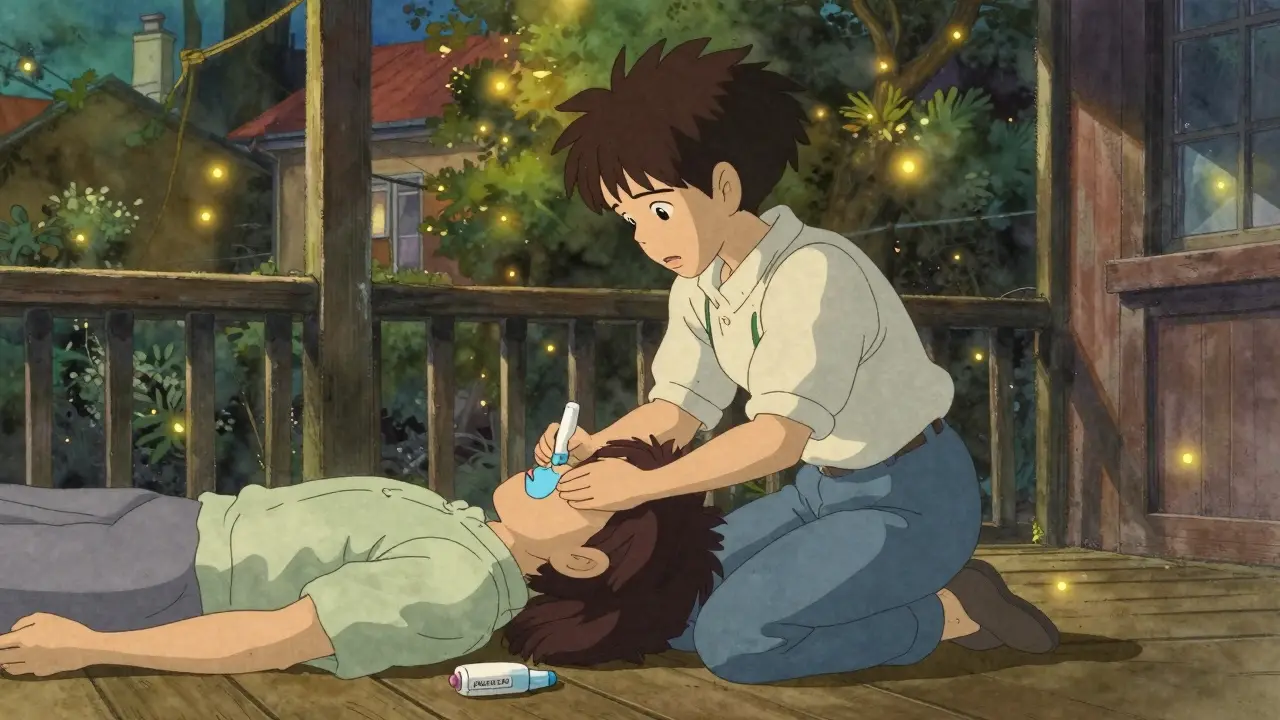
Someone you know is unconscious. Their breathing is slow, shallow, or gone. Their lips are blue. You’re scared. You think: overdose. But you don’t know what to do next. You’re not a doctor. You don’t have a medical degree. You just want to help before it’s too late.
Here’s the truth: you don’t need to be an expert. You just need to act-fast and right. In the 4 to 6 minutes before emergency crews arrive, your actions can mean the difference between life and death. Studies show bystander intervention can cut overdose deaths by up to half. You don’t need to fix everything. You just need to keep their body alive until help gets there.
Step 1: Check for responsiveness and breathing
Don’t shake them or yell too loud. That wastes time. Instead, tap their shoulder firmly and shout, "Are you okay?" If there’s no response, immediately check their breathing. Look at their chest. Listen at their mouth. Feel for air on your cheek.
Gasping, snoring, or irregular breaths aren’t normal breathing. They’re signs of severe oxygen deprivation. This is not sleep. This is overdose. If they’re not breathing normally-or not at all-you have to act now.
Step 2: Call for emergency help
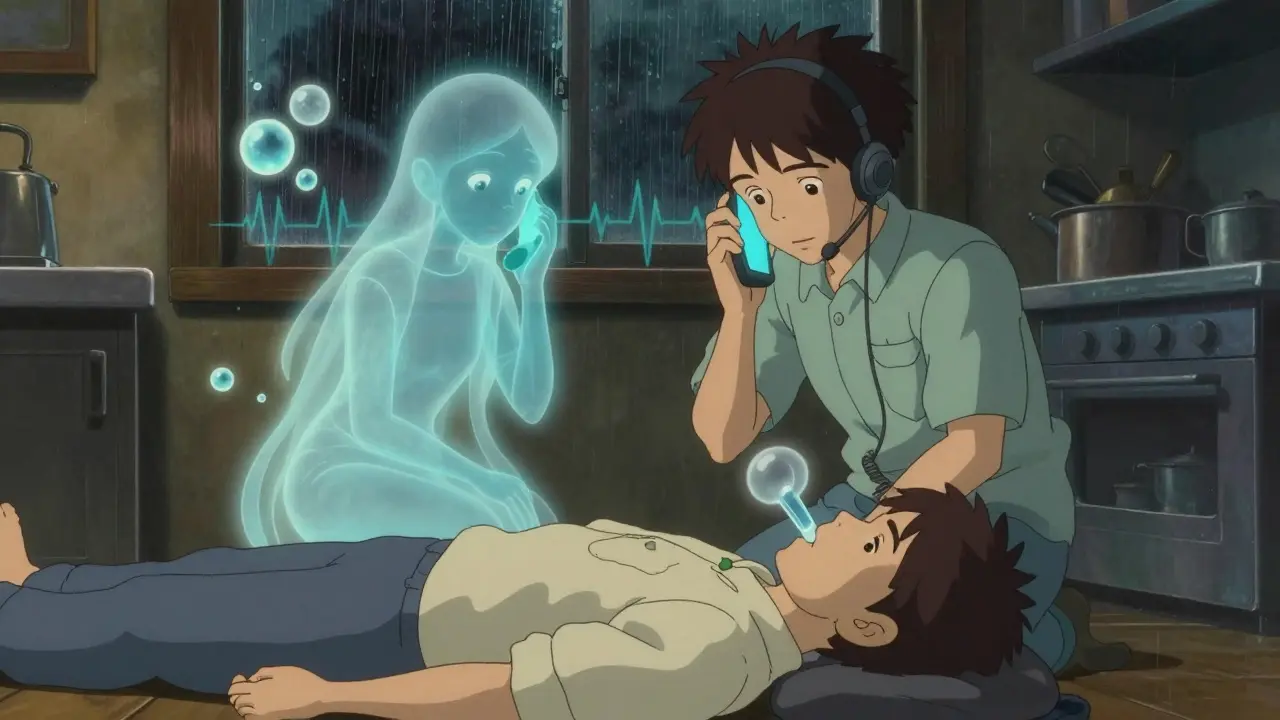
Call 000 (Australia) or 911 (US) immediately. Don’t wait to find naloxone. Don’t try to wake them longer. Don’t assume they’ll "sleep it off." The single most important thing you can do is get professional help on the way. Emergency services reduce overdose mortality by 35% compared to waiting for spontaneous recovery.
While you’re on the phone, stay calm. Tell them: "Someone is unresponsive and not breathing normally. I suspect an overdose." Give your location clearly. If you’re in a building, say the floor and unit number. If you’re outside, describe nearby landmarks. Stay on the line. The dispatcher might guide you through next steps.
Step 3: Give rescue breathing if they’re not breathing
If they’re unconscious but still have a pulse, you don’t need chest compressions. You need to keep oxygen flowing. Rescue breathing is your most powerful tool.
Place them on their back. Tilt their head back gently by lifting their chin. Pinch their nose shut. Seal your mouth over theirs. Give one slow breath-about one second long-until you see their chest rise. Don’t blow too hard. Don’t inflate their stomach. That can cause vomiting.
Then, take a breath yourself. Give another breath every 5 to 6 seconds. That’s about 10 to 12 breaths per minute. Keep going. Even if you’re tired. Even if you’re scared. Keep breathing for them. Most opioid overdoses don’t cause heart failure right away. They cause breathing to stop. You’re keeping their brain alive.
Step 4: Use naloxone if you have it-and you suspect opioids
Naloxone reverses opioid overdoses. That includes heroin, fentanyl, oxycodone, morphine. It does nothing for alcohol, benzodiazepines, cocaine, or MDMA. If you don’t know what they took, give it anyway. SAMHSA’s 2023 guidelines say: "Naloxone first for any suspected opioid involvement."
Most naloxone kits today are nasal sprays. Remove the cap. Insert the nozzle into one nostril. Press the plunger firmly for 2 to 3 seconds. Don’t spray it into both nostrils. One is enough. If they don’t respond after 2 to 3 minutes, give another dose in the other nostril.
Even if they wake up after the first dose, don’t stop. Naloxone wears off in 30 to 90 minutes. Opioids can stay in their system longer. They could slip back into overdose. Keep monitoring them. Keep giving rescue breathing if needed. And keep waiting for EMS.
Step 5: Put them in the recovery position if they’re breathing
If they’re breathing on their own but still unconscious, roll them onto their left side. This is the recovery position. It keeps their airway open and stops them from choking if they vomit.
Here’s how: Kneel beside them. Straighten their legs. Bend their nearest arm at 90 degrees, palm up. Place their far arm across their chest. Bend their far leg at the knee, foot flat on the ground. Gently roll them toward you, using their bent leg as a pivot. Tilt their head back slightly to keep the airway clear. Their top arm should be under their head. Their bottom arm should be out to the side.
Check their breathing every 2 to 3 minutes. Watch for changes. If they stop breathing, go back to rescue breathing immediately.
What NOT to do
Don’t put them in a cold shower or ice bath. That’s a myth. It can trigger dangerous heart rhythms, especially with stimulant overdoses.
Don’t try to make them walk. Don’t give them coffee or food. Don’t slap them. Don’t inject anything except naloxone if you’re trained and it’s available.
Don’t assume they’re just "sleeping." Overdose looks like deep sleep. But their breathing is too slow. Their skin is too pale. Their lips are blue. That’s not rest. That’s a medical emergency.
Special cases: stimulants and alcohol
If you think it’s cocaine, meth, or MDMA (ecstasy), the priority shifts. These drugs raise body temperature dangerously. You need to cool them down. Move them to a cool area. Remove excess clothing. Wet their skin with cool water. Use a fan. Don’t use ice packs directly on the skin-that can cause shock.
For alcohol overdose, the biggest risk is choking. Their gag reflex is shut down. Keep them on their side. Watch for vomiting. If they vomit, roll them onto their side immediately and clear their mouth with your fingers if needed. Don’t give them water. Too much fluid can cause dangerous electrolyte imbalances.
Why this works: the science behind the steps
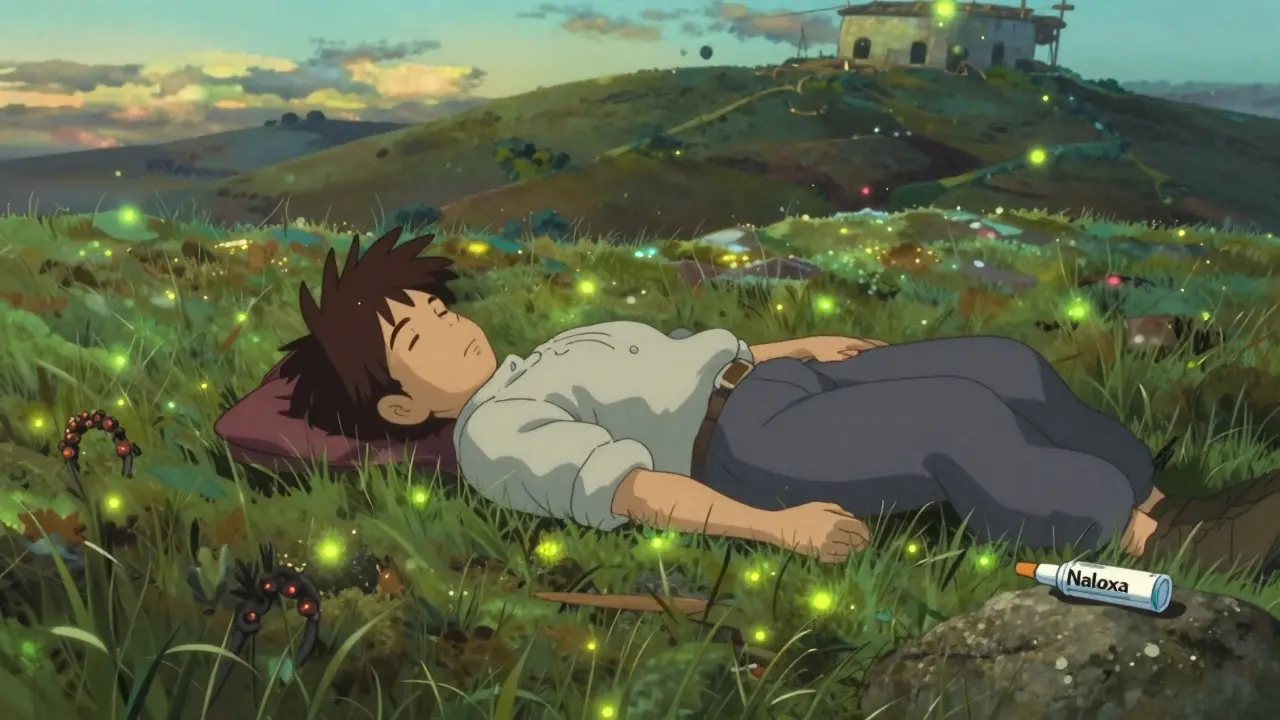
Opioid overdoses kill by stopping breathing. The brain needs oxygen. After 4 minutes without it, brain cells start dying. Rescue breathing keeps oxygen flowing. Naloxone blocks the opioids from binding to brain receptors, letting breathing restart. It’s not magic. It’s physiology.
Studies from the New England Journal of Medicine show that when bystanders give rescue breathing and naloxone together, survival rates jump to 98.7%. In communities where people only got naloxone without training, survival was only 87.3%. Training matters. Knowing the steps matters.
And here’s something most people don’t know: naloxone is safe. You can’t overdose on it. If they didn’t take opioids, it won’t hurt them. Giving it is never the wrong choice.
What happens after EMS arrives
Paramedics will give oxygen, start IV fluids, and monitor heart and brain function. They might give more naloxone. They’ll take them to the hospital. Even if they wake up, they need medical evaluation. Overdose can cause internal damage that doesn’t show up right away.
And yes-they might be angry. They might deny they took anything. They might refuse help. That’s normal. Your job isn’t to judge. Your job was to save their life. That’s enough.
Be ready next time
Keep a naloxone kit at home if you or someone you know uses opioids. They’re free or low-cost in many places-pharmacies, community centers, health clinics. In Australia, you can get them without a prescription. In the US, they’re now available over-the-counter in most states.
Take a free 45-minute online course from the American Red Cross or your local health department. Practice the recovery position with a friend. Learn how to recognize the signs. This isn’t about being a hero. It’s about being prepared.
Someone you care about could need you tomorrow. Don’t wait until then to learn what to do. The time to act is now. Because when it happens, you won’t have time to look it up on your phone. You’ll have to remember. And you will.
11 Comments
Cara C-22 December 2025
I’ve had to use naloxone twice now. First time I was terrified-I didn’t know if I was doing it right. But I did it anyway. The person woke up coughing, confused, but alive. That moment changed everything for me. You don’t need to be perfect. You just need to show up.
And yeah, naloxone is safe. Even if they didn’t take opioids, it won’t hurt them. So if you’re unsure-give it. No regrets.
Michael Ochieng-23 December 2025
Man, this is the kind of info that should be taught in high school. Like, right next to sex ed and budgeting. I grew up in a neighborhood where overdoses were common, but nobody ever talked about what to do. We just called 911 and hoped. This guide? It’s gold. I’m printing this out and handing it to my cousins.
Also, the recovery position thing? I didn’t know you had to bend the leg like that. Learned something new today.
Cameron Hoover-25 December 2025
I’m not gonna lie-I used to think people who OD’d were just weak. Like, ‘why don’t they just stop?’ But after watching my brother nearly die from fentanyl, I got it. It’s not about willpower. It’s about chemistry. Your brain gets hijacked.
This guide? It’s the most compassionate thing I’ve read all year. I cried reading the part about ‘your job isn’t to judge.’ That’s the truth. We need more of this. Not judgment. Not stigma. Just clear, calm, human instructions.
Also-naloxone should be in every public bathroom. Like fire extinguishers. It’s that important.
Sarah Williams-27 December 2025
Just saved someone’s life last month using this exact method. Rescue breathing for 8 minutes straight. Naloxone at 6. They’re alive. No brain damage. No hospital stay. Just a guy who got lucky because someone knew what to do.
Stop waiting to be trained. Just learn it now. It takes 15 minutes. You can do it.
Jay lawch-28 December 2025
Let me tell you something. This whole ‘naloxone saves lives’ narrative is a distraction. The real problem is the pharmaceutical industry and the government’s collusion with Big Pharma. They flooded our streets with opioids to profit from addiction. Now they give out free naloxone like it’s a band-aid on a hemorrhage.
Why aren’t we holding CEOs accountable? Why aren’t we shutting down pill mills? Why are we teaching people to be first responders instead of demanding systemic change? This guide is useful, sure-but it’s also a pacifier. We’re treating symptoms, not the disease.
And don’t get me started on how the media romanticizes ‘bystander heroes’ while ignoring the root causes. Wake up, people. This isn’t about CPR. This is about capitalism killing us slowly.
Christina Weber-28 December 2025
There are multiple grammatical errors in this article. For instance, ‘You don’t need to fix everything’-should be ‘You don’t need to fix everything.’ And ‘They’re free or low-cost in many places-pharmacies’-missing a space after the hyphen. Also, ‘SAMHSA’s 2023 guidelines say: “Naloxone first...”’-the colon should not precede a quote in formal usage.
Furthermore, the claim that ‘rescue breathing and naloxone together yield 98.7% survival’ is misleading without citing the specific study’s sample size or confounding variables. This is dangerously irresponsible content if presented as medical advice without peer-reviewed sourcing.
And why is ‘000’ listed for Australia? That’s incorrect. It’s 000 for emergency services, but only in landline contexts; mobile users should dial 112. This level of inaccuracy undermines credibility.
Dan Adkins-29 December 2025
It is with the utmost respect for the sanctity of human life that I offer this observation: while the procedural guidance provided herein is technically sound and commendable in its clarity, one must not overlook the profound moral imperative that underpins such actions. In many cultures, particularly those rooted in African communal ethics, the act of intervening in a life-threatening situation is not merely a medical duty-it is a spiritual obligation, a sacred covenant between individuals and the collective.
Furthermore, the normalization of naloxone distribution, while pragmatic, may inadvertently erode societal accountability if not paired with robust rehabilitation frameworks and cultural re-education. We must not confuse harm reduction with moral abdication.
Let us act with precision, yes-but let us also act with reverence.
Erika Putri Aldana-30 December 2025
why are we still teaching rescue breathing? like... it's 2024. isn't there a machine or something? like, a breathing robot? or at least an app? i mean, i'm tired of blowing into people's mouths 😑
also i think naloxone should be in every vending machine. like snacks. but instead of chips, it's life.
and why do people still think you can wake someone up by slapping them?? jeez. the myths are real.
Grace Rehman-31 December 2025
So we turn a medical emergency into a checklist and call it empowerment
Meanwhile, the people who need this the most? The ones who are already drowning in stigma, poverty, trauma, and neglect? They’re not reading Reddit guides. They’re trying to survive the next hour
And we’re patting ourselves on the back for knowing how to give breaths to strangers while our hospitals are underfunded, our therapists are booked for a year, and our lawmakers still treat addiction like a moral failure
Do the thing. Yes. But don’t pretend this fixes anything
It’s not heroism. It’s damage control
And we’re all just waiting for the next one to happen
Jerry Peterson- 2 January 2026
My mom used to work in ER. She said the hardest part wasn’t the drugs or the chaos-it was the silence after they woke up. No one knew what to say. So they just stared.
This guide? It’s the first thing I printed and taped to my fridge. I keep a kit in my car now. I showed my nephew how to use it last weekend. He’s 14. He didn’t laugh. He just nodded.
That’s how it spreads. Not with speeches. Just one person, one kit, one moment of courage.
Thanks for writing this. Real talk.
Cara C- 4 January 2026
Just read Jerry’s comment. That’s exactly it. It’s not about being a hero. It’s about being someone who doesn’t look away.
I used to think I’d freeze if it happened to me. But when it did, I didn’t think. I just moved. And that’s all any of us need to do.
Next time you’re at the pharmacy, grab a naloxone kit. Keep one in your bag. Give one to a friend. Don’t wait for a crisis to learn how to save a life.
It’s not complicated. It’s just human.