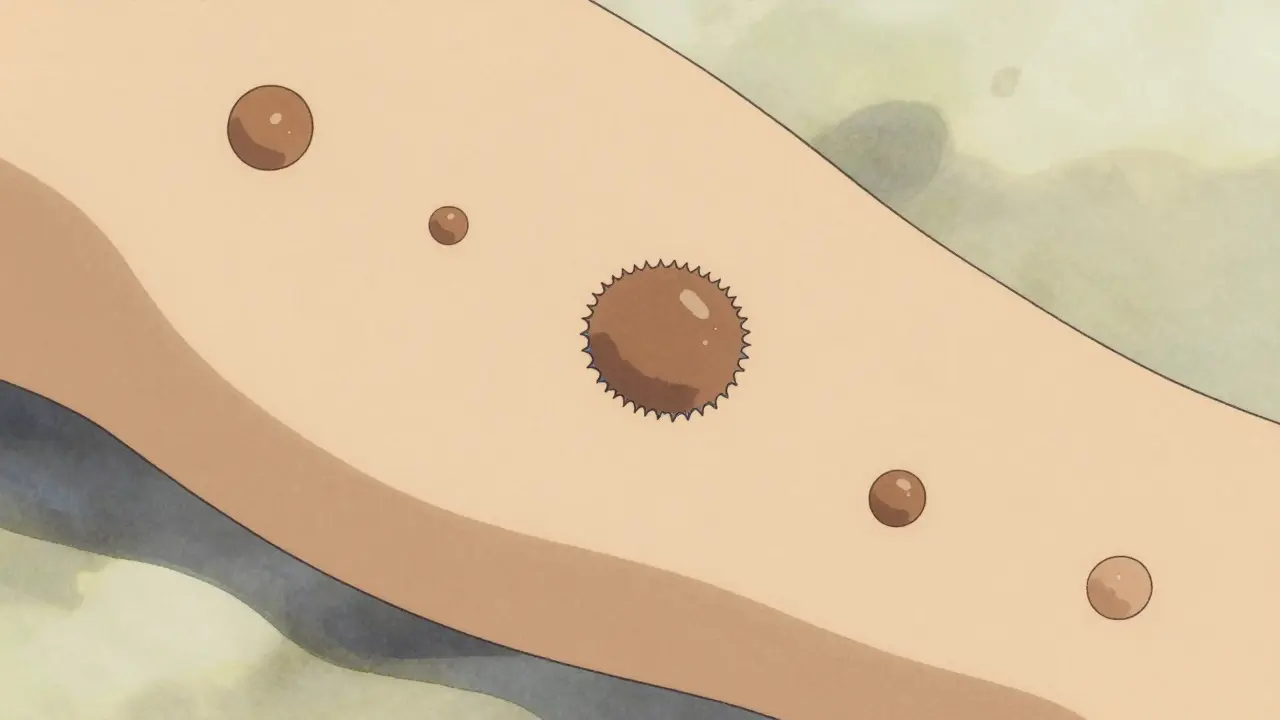
Most people have moles. Some have a few. Others have dozens. They’re usually harmless, harmless enough that you might not even notice them anymore. But one mole, just one, can turn dangerous - and fast. Melanoma, the deadliest form of skin cancer, often starts as a mole that looks a little off. The problem? It doesn’t always look like what you expect. That’s why the ABCDE rule matters - not because it’s perfect, but because it’s the simplest tool you have to catch it early.
What the ABCDE Rule Actually Means
The ABCDE rule isn’t magic. It’s a checklist. Dermatologists created it in the 1980s to help both doctors and regular people spot warning signs in moles. It’s short, easy to remember, and backed by decades of data. Here’s what each letter stands for:- A - Asymmetry: If you draw a line through the middle of the mole, both sides don’t match. A normal mole is round or oval and balanced. A melanoma looks like it was drawn by someone with a shaky hand.
- B - Border irregularity: Healthy moles have smooth, even edges. Melanomas often have jagged, notched, or blurred borders. Think of it like a stain bleeding into the skin.
- C - Color variation: A benign mole is usually one shade - light brown, dark brown, or tan. Melanomas? They mix colors. You might see black, red, white, or blue all in the same spot. Even a tiny streak of blue can be a red flag.
- D - Diameter: Traditionally, doctors said anything bigger than 6 millimeters (about the size of a pencil eraser) needs checking. But here’s the catch: 30% of melanomas are found at less than 6mm. Some dermatologists now use 5mm as the cutoff. The real issue isn’t size alone - it’s whether the mole is darker than the others around it. That’s why some experts now say ‘D’ stands for both ‘Diameter’ and ‘Dark’.
- E - Evolving: This is the most important letter. Any change over time - growing, itching, bleeding, crusting, or changing color - should be checked. Even if the mole looks fine on paper, if it’s not the same as it was six months ago, it’s suspicious.
These signs aren’t just for doctors. You’re the one who sees your skin every day. If you notice even one of these changes, don’t wait. Don’t assume it’s nothing. Don’t check again next month. See a dermatologist.
Why the ABCDE Rule Falls Short
Here’s the uncomfortable truth: the ABCDE rule misses a lot of melanomas. A 2022 study of over 140 melanoma cases found that nearly a third of them were in situ - the earliest, most treatable stage - and only 33% of those showed the ‘E’ sign. That means one in three early melanomas didn’t evolve noticeably before they were found.Some melanomas don’t follow the rules at all. Desmoplastic melanoma, for example, often looks like a scar - flat, flesh-colored, and symmetrical. Childhood melanomas? They’re even trickier. Only 18% of them fit the ABCDE pattern. And then there’s the ‘ugly duckling’ sign - the mole that looks completely different from all the others on your body. That’s often the first clue dermatologists notice.
One Reddit user shared how their melanoma was perfectly symmetrical, uniform in color, and only 3mm wide - none of the ABCDE criteria applied. It was stage IIB. Another user said they delayed seeing a doctor because their mole didn’t meet enough ABCDE criteria. They waited 7 months. That’s the cost of relying too heavily on a checklist.
The ABCDE rule is a starting point, not a final answer. It’s like a smoke alarm - it won’t catch every fire, but it saves lives when it goes off.

When Do You Need a Biopsy?
Not every weird-looking mole needs to be cut out. But some definitely do. Dermatologists don’t just go by ABCDE. They look at the whole picture:- Three or more ABCDE features: If your mole checks off three or more boxes, the chance it’s melanoma jumps significantly. Studies show this triggers biopsy in 85% of true cases.
- Documented change over time: If you’ve taken photos of your mole and can show your doctor it’s grown or changed in the last 3-6 months, that’s a stronger reason for biopsy than any single ABCDE sign. Change is the #1 predictor.
- The ugly duckling: One mole that stands out from the rest? That’s enough to warrant removal, even if it looks fine by ABCDE.
Here’s what most dermatologists won’t tell you: they often biopsy moles that look borderline - not because they’re sure it’s cancer, but because they can’t be sure it’s not. That’s why 4.7 benign moles are removed for every one melanoma caught. It’s expensive - $417 million a year in the U.S. alone - but it’s better than missing a deadly one.
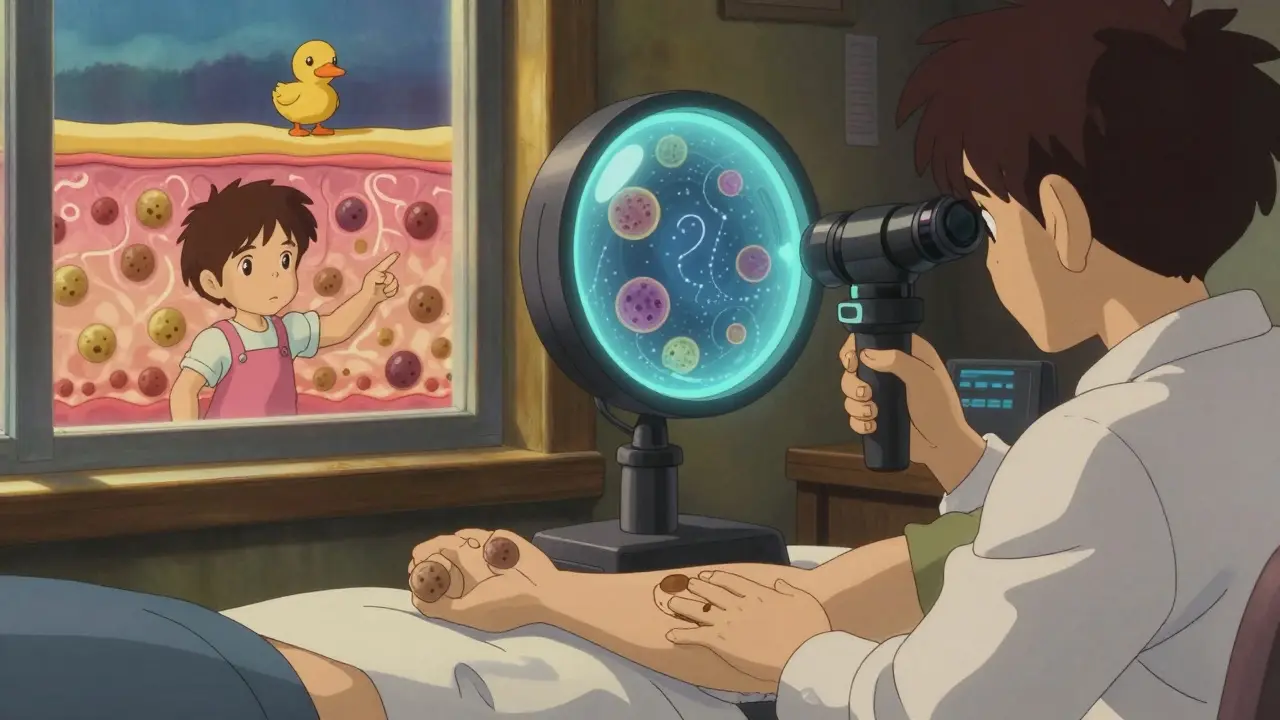
Some clinics now use digital dermoscopy - a magnified camera that shows skin layers you can’t see with the naked eye. It boosts accuracy from 75% to 92%. But you won’t get this unless you go to a dermatologist. For most people, it’s still about what you see in the mirror.
What You Should Do Right Now
You don’t need to be a doctor to protect yourself. Here’s what works:- Check your skin monthly. Use a full-length mirror and a hand mirror. Don’t skip your scalp, back, soles, or between your toes. Use a body mole map - the American Academy of Dermatology’s tool has been downloaded over 1.2 million times.
- Take photos. Snap a picture of any mole you’re worried about. Do it again in 3 months. If it’s changed, go in. Even a phone camera is better than memory.
- Know your ‘ugly ducklings’. Look at all your moles. Which one looks like the odd one out? That’s the one to show your doctor.
- Don’t wait for all five signs. One change - especially if it’s new bleeding, itching, or rapid growth - is enough to get it checked.
- Don’t ignore moles under 6mm. Most melanomas are found early. Early means small. Small doesn’t mean safe.
There’s no magic number. No perfect formula. If something feels wrong - if you have a gut feeling - trust it. You’ve lived with your body longer than any doctor has.
The Future of Melanoma Detection
The ABCDE rule isn’t going away. But it’s changing. Dermatologists are moving toward multi-step checks:- AI tools: Apps like SkinVision, approved by the FDA in 2022, use AI trained on over 12 million skin images. They analyze moles for ABCDE plus hidden patterns - and they’re 95% sensitive at catching melanoma.
- Molecular tests: Some clinics now use a 23-gene test (DecisionDx-Melanoma) on biopsy samples to predict how aggressive a melanoma is. This helps avoid unnecessary surgeries in low-risk cases.
- Updated guidelines: The U.S. Preventive Services Task Force is updating its recommendations. The new draft emphasizes ‘change over time’ as the most critical factor - not size or color alone.
By 2027, experts predict the ABCDE rule will be the first step - not the last. You’ll still use it at home. But when you go to the doctor, they’ll combine it with dermoscopy, AI, and maybe even blood markers. The goal isn’t to replace you. It’s to give you better tools.
Final Thought: Your Eyes Are Your Best Tool
Melanoma kills. But it’s also one of the most preventable cancers - if caught early. Stage 0 melanoma has a 99% five-year survival rate. Stage IV? That drops to 32%. That gap isn’t because of treatment. It’s because of detection.You don’t need expensive gadgets. You don’t need to be an expert. You just need to know what to look for - and act when something doesn’t feel right. The ABCDE rule isn’t perfect. But it’s better than doing nothing. And sometimes, that’s all it takes to save a life.



14 Comments
Mark Alan-28 January 2026
OMG I JUST REALIZED MY MOLE IS ASYMMETRICAL AND HAS A BLUE TINT?? 😱 I’M GOING TO THE DERMATOLIGIST TOMORROW. IF I DIE, TELL MY CAT I’M SORRY. 🐱💔
Amber Daugs-29 January 2026
Honestly, people who wait for "all five signs" are playing Russian roulette with their skin. If you have a mole that looks "off," it doesn’t matter if it’s 3mm or symmetrical-you’re not a dermatologist. Stop being lazy and get it checked. Your future self will thank you. 🙄
Robert Cardoso-29 January 2026
The ABCDE rule is a heuristic, not a diagnostic tool. It was designed for triage, not confirmation. The 2022 study you cited actually demonstrates the limitations of binary classification systems in complex biological contexts. Melanoma is a heterogeneous disease-relying on visual heuristics ignores molecular heterogeneity, immune microenvironment dynamics, and epigenetic drift. The real problem isn’t the rule-it’s the public’s overreliance on oversimplified models. We need population-level genomics, not mirror checks.
SRI GUNTORO-30 January 2026
In my country, we don’t wait for signs. We check every mole every month. If you don’t know your body, how can you expect others to care? This is not just about skin-it’s about responsibility. You think you’re safe because you’re young? Think again.
Kevin Kennett-30 January 2026
I used to ignore my moles too-until my cousin got diagnosed with stage III after saying "it was probably nothing." Now I take photos of every new bump, and I make my kids do monthly skin checks with me. It’s weird, it’s awkward, but it’s saved lives. Don’t be the person who says "I’ll check it next month." Next month might be too late.
Rose Palmer- 1 February 2026
The ABCDE rule is an essential first-line screening instrument, and its utility is empirically validated across multiple longitudinal cohorts. However, its predictive sensitivity is contingent upon patient literacy and observational consistency. It is imperative that primary care providers integrate this tool into routine wellness examinations, particularly for individuals with Fitzpatrick skin types I–III. Early detection remains the most cost-effective intervention in oncology.
Howard Esakov- 2 February 2026
Honestly, if you’re using a phone camera to track moles, you’re doing it wrong. Real dermatologists use dermoscopes with polarized light and AI-assisted analysis. You think your selfie with flash and bad lighting is equivalent? Please. You’re not a clinician. Go see one. And stop posting about it like it’s a TikTok trend. 🤦♂️
fiona vaz- 4 February 2026
I’m not a doctor, but I’ve had two benign moles removed just because they felt "wrong." One itched constantly. The other changed shape after a sunburn. I didn’t wait for the ABCDE checklist-I trusted my gut. And I’m alive because of it. Don’t wait for permission to act.
John Rose- 4 February 2026
I’ve been tracking my moles for five years with monthly photos. I’ve noticed one that’s slowly gotten darker-no itching, no bleeding, but it’s just… different. I’ve scheduled my appointment for next week. It’s not panic. It’s prevention. And honestly? It’s the most responsible thing I’ve done for my health.
Lexi Karuzis- 6 February 2026
You think the ABCDE rule is enough? HA! The government doesn’t want you to know that the FDA approves AI apps only after pharmaceutical lobbying. And the 4.7 benign moles removed for every melanoma? That’s a profit scheme. They’re harvesting your fear. Your mole might be fine. But they’ll biopsy it anyway-because insurance pays. Don’t be fooled.
Brittany Fiddes- 8 February 2026
I’ve lived in the UK for 12 years, and I’ve never seen anyone here check their moles. We’re too polite to be alarmed. But I’ve had two friends die from melanoma-both dismissed their moles as "just pigmentation." If you’re British and you’re reading this: stop being so bloody reserved. Look at your skin. Or don’t. But don’t blame me when you’re gone.
Colin Pierce- 9 February 2026
I work in a dermatology clinic. We see this every week. Someone comes in saying, "It’s been there for years," but they never took a photo. Then they say, "I thought it was normal." But it wasn’t. The ones that get caught early? They’re the ones who took the time to notice. You don’t need a degree. You just need to care enough to look.
Lance Long- 9 February 2026
I used to think moles were just part of my skin. Then I saw my dad’s melanoma under his foot-no color change, no border, just a tiny black dot. He didn’t feel it. He didn’t notice it. He didn’t even know it was there until it was stage IV. I check my feet every single day now. I check my scalp. I check my butt. I check my kids. I don’t care if it’s weird. I care that they’re alive.
Timothy Davis-11 February 2026
The ABCDE rule is statistically underpowered for early-stage detection. The sensitivity for in situ melanoma is 41%. The specificity is 89%. That means nearly 60% of melanomas are missed using this method alone. The real solution is not better heuristics-it’s universal dermoscopic screening paired with machine learning. Until then, you’re gambling with your life using a 1980s checklist.